
Air Purifier Buying Guide: Size, Filters, Noise, Cost
Match an air purifier to the room and pollutant first, then compare noise, replacement filters, safety features, and placement. This guide turns those factors into a practical buyer checklist.
- Desk
- Home & Lifestyle
- Checked
- Aug 26, 2026
- By
- My Deal Junction Buyer Desk
An air purifier is easier to choose when you stop treating "more filtration" as a single performance number. The useful questions are how large the room is, what type of contaminant you are trying to reduce, how much noise you can tolerate, and what the filters will cost to replace. Those factors determine whether a purifier fits the room and whether you will realistically keep using it.
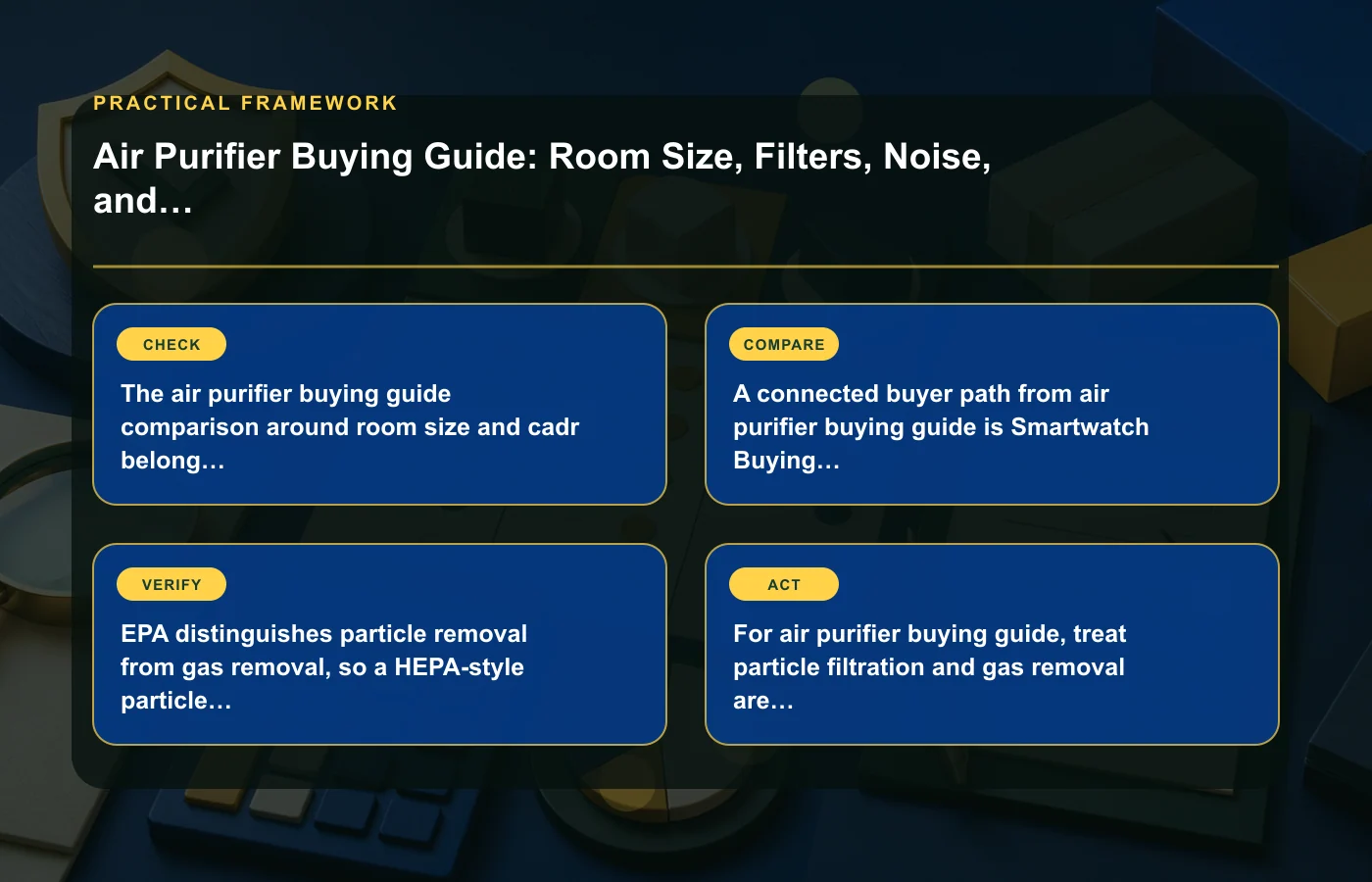
EPA guidance for portable air cleaners connects particle-cleaning capacity with room size, and it distinguishes particle removal from gas removal. That makes two common shortcuts risky: choosing by a large headline specification without matching it to the room, and assuming a particle filter automatically solves odor or gas concerns.
| Decision factor | What to compare | Why it matters |
|---|---|---|
| Room size and CADR | Rated particle-cleaning capacity for the room you will actually use | An undersized unit may require higher fan speeds or provide less useful cleaning |
| Particle vs. gas filtration | Filter type and the pollutant you are targeting | Different filtration mechanisms address different problems |
| Replacement filters | Replacement interval, availability, and ongoing cost | Ownership expense continues after purchase |
| Noise | Sound at the fan setting you expect to run | A purifier that is too loud may be used less often |
| Placement and airflow | Clearance and intended location | Blocked intake or exhaust can undermine practical performance |
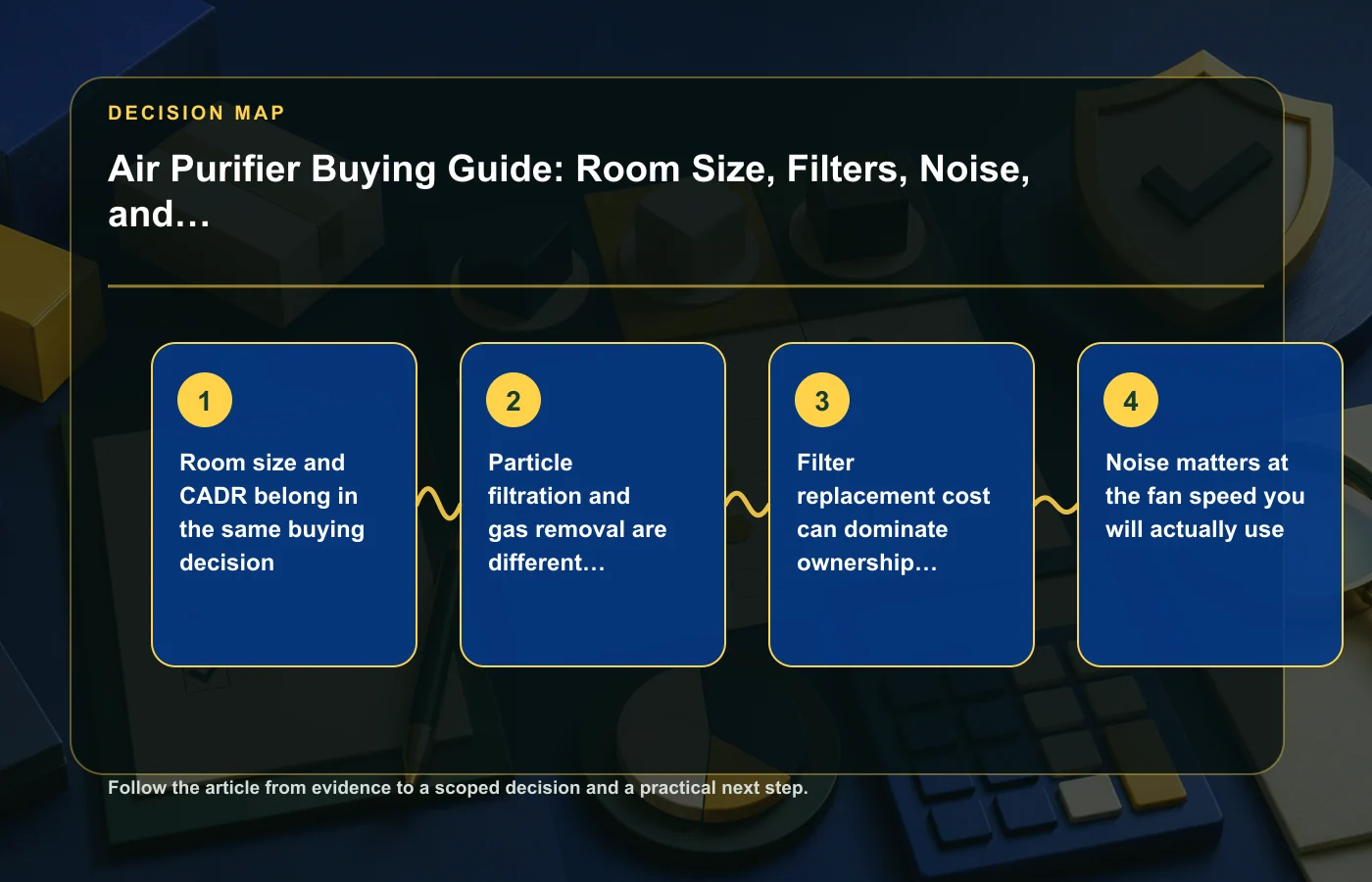
Match room size and CADR before comparing extras
The first job of an air purifier is to move and clean enough air for the space where it will operate. EPA home-air-cleaner guidance says portable cleaners should have a CADR appropriate for the size of the room for particle filtration. That makes room fit a more useful starting point than app features, display design, or a long list of modes.
Measure the room you care about rather than relying on a vague label such as "bedroom" or "large room." Then compare the manufacturer's room-size information and CADR data for the exact model. If the product page uses several room-size claims, check what assumptions sit behind them. A generous coverage claim is not necessarily comparable with another brand's claim if the underlying air-change assumptions differ.
Think about how you will actually run it
A purifier can only help when it is operating. If the room requires a high fan setting that you find too loud, the theoretical room rating may not describe your real use. For a bedroom, office, or living space, ask whether the capacity you need is available at a setting you are willing to leave on for long periods.
- Record the room dimensions or area.
- Identify the particle-cleaning performance stated for the exact model.
- Note which fan speed corresponds to the noise level you can tolerate.
- Leave margin for doors, open-plan layouts, or unusual room geometry instead of assuming every space behaves identically.
The same discipline applies in other appliance categories: compatibility comes before headline features. The site's smartwatch buying guide uses the same buyer-first principle in a different context.
Particle filtration and gas removal are different jobs
A filter designed to capture airborne particles should not automatically be treated as a complete solution for gases or odors. EPA guidance separates these performance questions. For the buyer, that means you need to define the problem before deciding which filter description matters.
If your concern is dust, smoke particles, pollen, or another particulate issue, focus on the product's particle-filtration information and room-size suitability. If odors or gases are part of the reason for buying, look for information that specifically addresses gas removal rather than assuming a HEPA-style particle filter covers both.
Avoid feature-name shortcuts
Marketing language can compress several different technologies into one product story. Instead of asking whether a purifier has "advanced filtration," break the claim into stages. What captures particles? What, if anything, is intended for gases? Is the replacement filter the same type as the original? Which claims come from the manufacturer, and which are simply seller wording?
This prevents overbuying as well as underbuying. You do not need every possible filter stage merely because it exists; you need a configuration that addresses the pollutants and room conditions relevant to your use.
Filter replacement can dominate long-term ownership
The purchase price is only the entry cost. Filters are consumable components, and replacement frequency, availability, and price can materially change the cost of owning the purifier. A model that appears attractive up front may become inconvenient if replacement filters are hard to source or if the maintenance schedule does not fit your budget.
Before buying, check the manufacturer's current replacement guidance for the exact filter set. Separate washable or reusable components from parts that must be replaced. If several filter stages have different maintenance intervals, list them separately rather than averaging them into one vague annual estimate.
Build a simple ownership check
- Which filters are replaceable?
- How does the manufacturer describe the replacement interval?
- Are genuine replacements currently listed for the model?
- Are multiple filters required at the same time?
- Does the warranty or maintenance guidance require a particular replacement type?
Do not invent future costs from today's listing. Use current filter information to understand the maintenance burden, then recheck availability before purchase. If you are comparing household devices more broadly, the robot vacuum buying guide also shows why consumables and maintenance belong in the buying decision.
Noise matters at the setting you will actually use
Noise specifications are useful only when they correspond to the fan speed and mode you expect to run. A purifier can be quiet on its lowest setting and considerably more noticeable when moving more air. For a sleeping space, call area, or focused-work environment, usable noise is part of performance because it affects whether you will leave the machine running.
Compare the manufacturer's sound information by setting when that detail is available. If only one sound figure is presented, do not assume it represents every operating mode. Also consider where the purifier will sit: a unit placed close to a bed or desk may feel more intrusive than the same unit across a larger room.
Choose the compromise deliberately
The practical tradeoff is between airflow, cleaning rate, and sound. You do not need to predict exact in-room acoustics before purchase, but you can reject options that only meet your desired room coverage at a fan setting you know you will avoid. This is more useful than selecting the quietest headline number in isolation.
Treat ozone-producing features with particular caution
Air-cleaning technologies are not interchangeable, and the source material specifically flags ozone-related concerns. When a purifier includes an ionizing, ozone-generating, or similar feature, do not assume that an additional technology automatically improves the purchase. Read the manufacturer information and relevant safety guidance for the exact feature.
The safest buyer workflow is to separate optional features from the core filtration function. If a feature can be disabled, verify that before relying on it. If the product's safety or emissions information is unclear, treat that uncertainty as a reason to keep comparing rather than as a gap you should fill with marketing claims or user anecdotes.
What to verify
- Whether the feature is always active or user-controlled.
- How the manufacturer describes its purpose.
- Whether current safety or regulatory guidance applies to that technology.
- Whether the purifier still meets your needs without the optional feature.
This is a category where "more technology" is not automatically better. A simpler product with clear filtration and maintenance information can be easier to evaluate than one whose additional functions are poorly documented.
Placement and airflow can change practical performance
A purifier needs access to room air. Placing it where furniture, walls, curtains, or other objects restrict intake or exhaust can reduce the usefulness of its rated performance. Check the manufacturer's placement and clearance guidance before deciding where the unit will live.
Also think about whether the location is realistic for daily use. You may need access to a power outlet, room to remove filters, and enough clearance to avoid blocking vents. If the only workable location conflicts with the manufacturer's airflow guidance, that is a fit problem rather than something to solve after the purchase.
Use a location test before ordering
Choose the intended spot and ask four questions: Is there adequate clearance? Can air enter and leave the unit freely? Can you access the filters for maintenance? Will the power cord reach without creating an awkward setup? A few minutes of planning can eliminate models that look suitable on specifications but do not fit the room.
For more household purchase frameworks built around fit and maintenance rather than hype, see the home and lifestyle guides.
A practical air-purifier checklist
Before comparing prices, build a one-page specification for your room. Start with the size and the problem you want to address. Then add the maximum noise you are willing to accept, the maintenance you are willing to perform, and any feature you consider a disqualifier. This keeps the comparison tied to your actual use instead of whichever product page has the longest feature list.
- Define the room: size, intended location, and likely operating hours.
- Define the contaminant: particles, gases/odors, or a combination.
- Check capacity: room-size guidance and particle-cleaning information.
- Check ownership: replacement filters, maintenance access, and energy-use information if provided.
- Check comfort: noise at the setting you expect to use.
- Check safety: review any ozone-producing or ionizing feature separately.
If two models satisfy the same requirements, you can then compare transaction terms and current cost. If one model leaves a key requirement unverified, do not score it as equal simply because the missing information is inconvenient to find.
Verify each claim with the responsible source
Different parts of the purchase belong to different sources. Use the manufacturer for model specifications, filter compatibility, operating instructions, and maintenance guidance. Use the seller for the exact bundle, condition, return policy, and transaction terms. Use regulator or public-health guidance when the question is about safety rather than convenience. Keeping those roles separate reduces the risk of treating a seller summary as technical documentation or treating a general safety page as a model-specific performance claim.
When two sources appear to conflict, prefer the source responsible for that particular fact and note the uncertainty instead of combining the statements into a new assumption.
FAQ: Choosing an air purifier
Is a higher CADR always better?
Not as a standalone answer. CADR should be considered in relation to room size and the type of particle filtration you need. A larger number does not remove the need to check noise, maintenance, and placement.
Does a HEPA-style filter remove odors and gases?
Not automatically. The source material follows EPA guidance in treating particle removal and gas removal as different performance questions. Check whether the product includes a stage specifically intended for the problem you are trying to address.
How important is replacement-filter cost?
It can be a major part of ownership because filters are recurring consumables. Check replacement guidance and current availability before buying rather than evaluating only the initial purchase.
Can I put the purifier anywhere in the room?
No universal placement works for every model. Follow the manufacturer's intake, exhaust, and clearance instructions, and make sure the location is practical for filter changes and daily operation.
How this page was prepared
Reviewed by My Deal Junction Standards Editor. Claims, terminology, and time-sensitive details were checked against the sources listed below and the page was last updated August 26, 2026.
AI-assisted tools supported research organization or drafting; editorial review remained responsible for source selection and the published conclusions.
Sources and verification
Primary and authoritative references used to verify this article: