
Carry-On Luggage Guide: Size, Weight, Wheels, Materials
A carry-on label is not a universal airline guarantee. Verify carrier limits first, then compare full dimensions, empty weight, construction, wheels, organization, and battery rules.
- Desk
- Home & Lifestyle
- Checked
- Sep 18, 2026
- By
- My Deal Junction Buyer Desk

A bag marketed as "carry-on" is not a universal guarantee that every airline will accept it in the cabin. Airlines set their own size and weight policies, while TSA rules address security screening and battery carriage rather than airline baggage dimensions. The safest purchase starts with the airline rules for the trips you actually take, then checks the bag's external measurements—including wheels and handles.
After fit comes usability: soft-sided versus hard-sided construction, wheel layout, interior organization, empty weight, and any battery-equipped features. A good carry-on is not the bag with the most compartments or the strongest marketing claim; it is the one that fits your carrier constraints and packing habits without creating avoidable weight or space problems.
| Buyer check | What to verify | Why it matters |
|---|---|---|
| Airline limit | Current size and weight rules for your carrier/fare | "Carry-on" labeling does not override airline policy |
| External size | Case plus wheels, feet, and handles | Hardware can push a bag beyond the allowed dimensions |
| Empty weight | Bag weight before packing | A heavy shell leaves less allowance for contents where weight limits apply |
| Wheel layout | Two-wheel vs. four-wheel geometry and external hardware | Changes maneuverability and usable case volume |
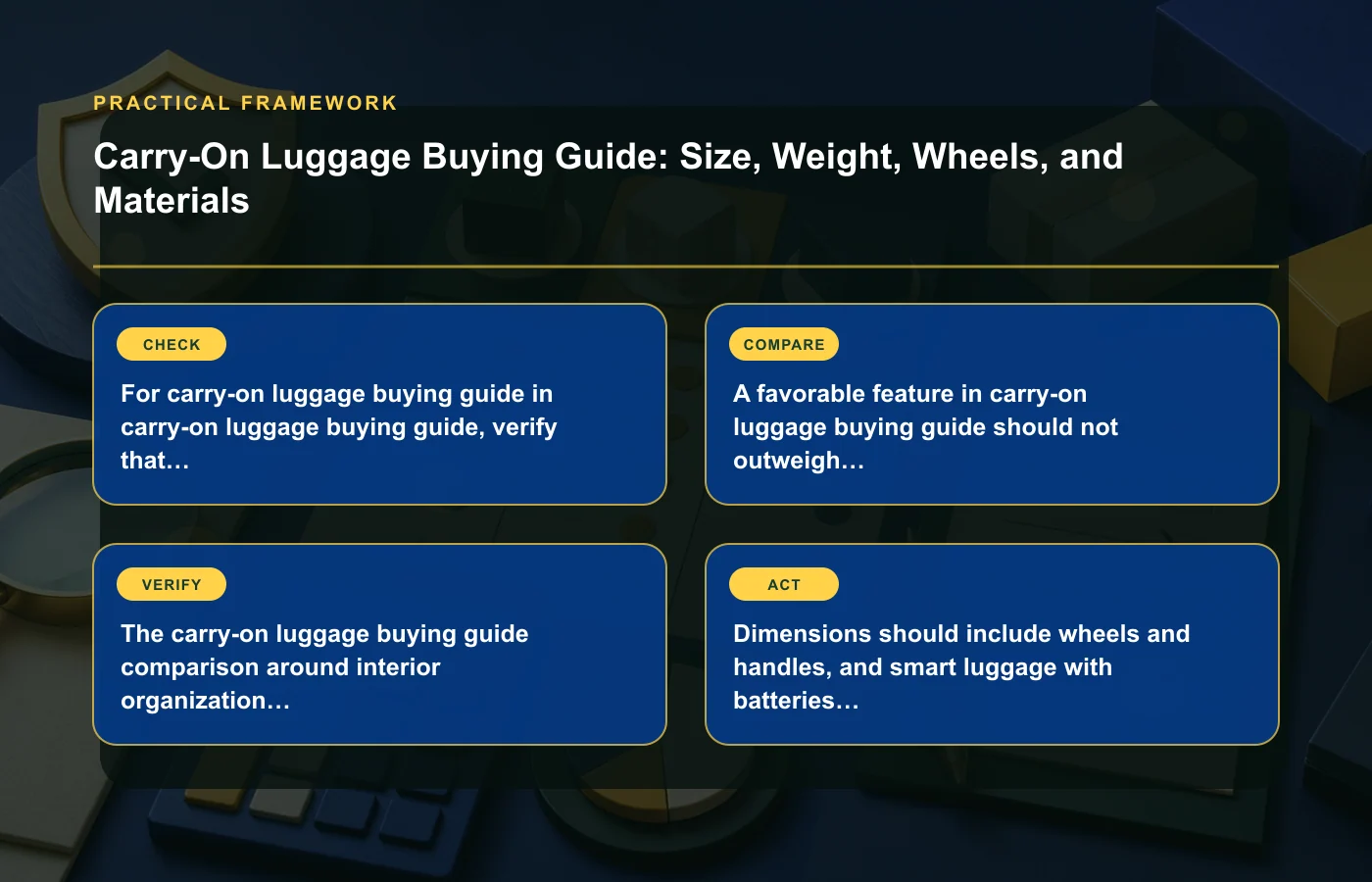
| Battery features | Battery type, removability, and current airline rules | Smart luggage can create separate carriage restrictions |
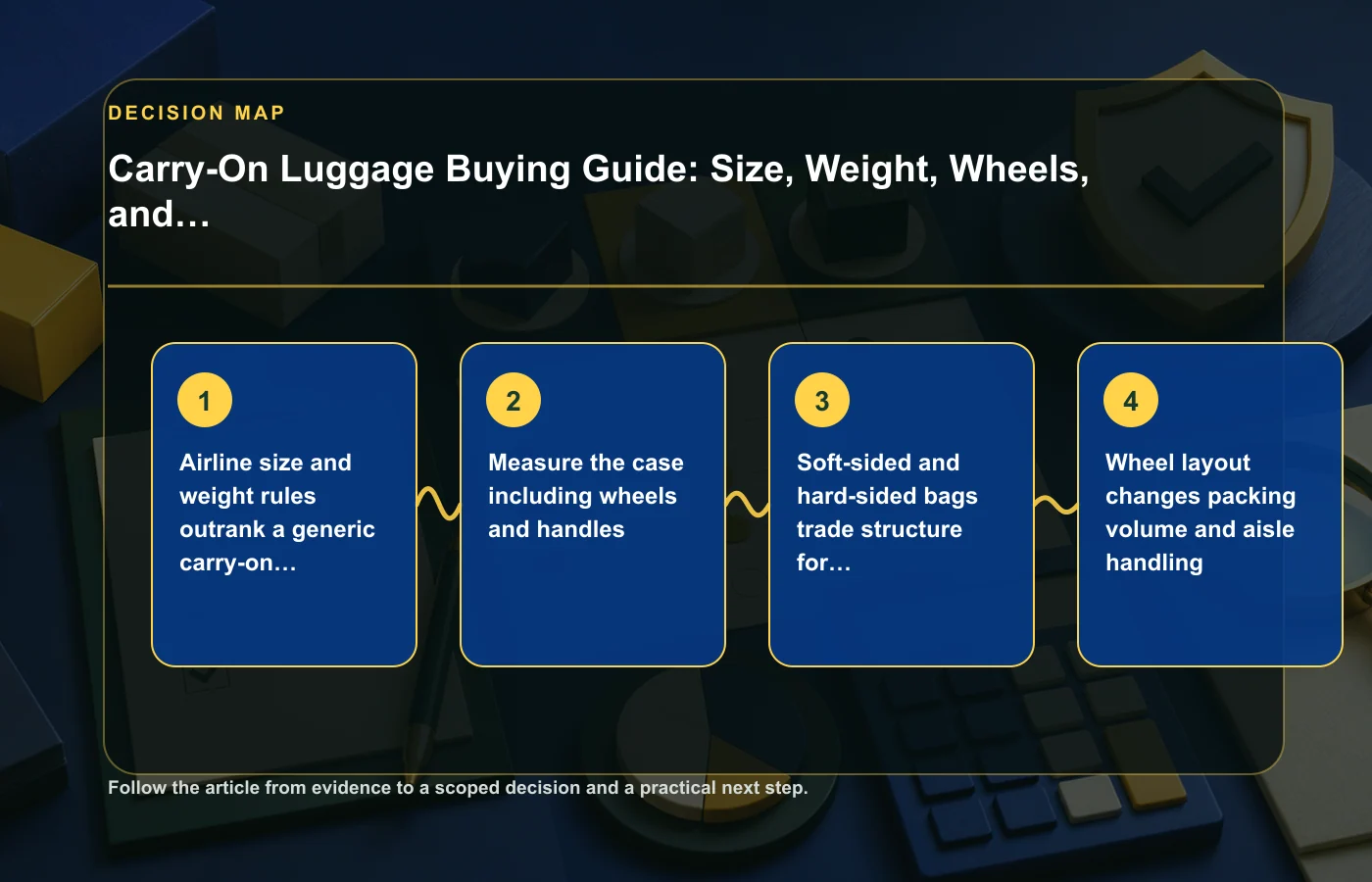
Airline rules outrank a generic carry-on label
The first step is not measuring the bag—it is identifying the rules you need the bag to satisfy. A frequent traveler may use several airlines with different cabin-baggage policies. A bag that fits one carrier can be oversized or overweight for another.
Check the airline's current baggage page for the route and fare type you expect to use. Some policies separate cabin bags from personal items, and weight enforcement can matter as much as dimensions. The source material does not establish one global carry-on standard, so avoid buying from a universal "airline approved" claim without verifying the carriers that matter to you.
Build your own maximum envelope
- List the airlines you use most often.
- Record each current cabin-bag size limit.
- Record any cabin-bag weight limit.
- Note whether the fare you normally buy includes a carry-on.
- Use the most restrictive rule you want the bag to satisfy.
If you travel only occasionally on a stricter carrier, you may choose to accept that tradeoff. The key is to make it deliberately rather than discovering it at the gate.
Measure the case including wheels and handles
Luggage dimensions can be confusing because a manufacturer may describe the packing compartment separately from the bag's total external size. Airlines generally care about the overall object that must fit in the cabin or sizing device. Wheels, feet, bumpers, and fixed handles can therefore matter.
Use the manufacturer's external dimensions when they are clearly stated, then verify how those measurements are defined. If you already own the bag, measure the longest points yourself. Expandable sections should be considered in the expanded state if you plan to use them during travel.
A simple measurement check
- Place the empty bag on a flat surface.
- Measure total height from the floor/wheel edge to the highest fixed point.
- Measure total width at the widest external point.
- Measure total depth, including protruding structure.
- Repeat after expansion if the bag has an expandable section.
Keep those measurements beside your airline-rule notes. A capacity figure in liters can help compare internal volume, but it does not tell you whether the bag fits an airline's dimensional rule.
Soft-sided and hard-sided luggage trade flexibility differently
Soft-sided and hard-sided cases do not form a simple durability ranking. A rigid shell can provide more structure around the contents, while soft construction can offer external pockets or some flexibility in how the case is packed. The better choice depends on what you carry and how you use the bag.
Check the materials, zippers, seams, frame, and warranty terms rather than assuming "hard" means stronger or "soft" means lighter. Empty weight varies by design. If airline weight limits are important, compare the actual bag weight rather than the construction category.
Choose around packing behavior
- Do you need quick-access exterior pockets?
- Do you often pack rigid or fragile items?
- Do you prefer a lid that opens into two halves or a deeper single compartment?
- Does the case need to compress into a tight storage area at home?
- How important is empty weight for your airlines?
The home and lifestyle collection uses the same buyer principle across other categories: design choices should be evaluated against the way the product will actually be used.
Wheel layout changes handling and packing geometry
Two-wheel and four-wheel cases move differently. Four-wheel "spinner" layouts can roll beside the traveler and turn easily on smooth surfaces, while two-wheel designs often use a different external geometry and pulling motion. Neither layout is automatically superior for every route or surface.
Wheels also occupy physical space. Large external wheel assemblies can contribute to overall dimensions and can affect how much of the bag's outer envelope becomes usable packing volume. Check the total dimensions, not just the shell.
Think through the whole trip
Airport floors are only one part of travel. Consider sidewalks, curbs, train platforms, hotel carpets, narrow aisles, and the distance you expect to walk. A wheel system that feels excellent in a store can be less convenient on rough surfaces, while a design optimized for rougher pulling can feel different in tight indoor spaces.
When possible, test the handle extension and wheel movement with some weight in the bag. An empty-case demonstration does not reproduce the balance of a packed suitcase.
Interior organization can consume usable space
Dividers, compression panels, pockets, shoe sections, and padded compartments can make packing easier, but every organizer occupies some of the internal volume. A highly structured interior can be useful for one traveler and restrictive for another.
Look beyond the capacity number. Open the case and identify where the wheel housings, handle rails, dividers, and pockets intrude. Then compare that geometry with the shape of what you normally pack.
Pack by categories, not marketing features
- Clothing that can compress.
- Shoes or rigid objects.
- Electronics and chargers.
- Liquids/toiletries packed according to current travel rules.
- Documents or items that need fast access.
If you use packing cubes, measure your common cubes and check whether they fit the compartment layout efficiently. An organizer is valuable when it replaces work you would otherwise do, not simply because the product page lists more pockets.
The robot vacuum guide is unrelated as a product category but illustrates the same principle: usable geometry can matter more than a headline specification.
Smart luggage batteries have separate travel restrictions
Luggage with built-in charging or tracking features can introduce a battery question that ordinary bags do not have. TSA rules address battery carriage and security screening, while airlines may apply their own operating procedures. Check current rules before traveling with any battery-equipped case.
For a purchase, the critical question is whether the battery can be handled in the way current rules require. If removability matters, confirm that the battery is designed to be removed rather than assuming a hidden power bank can be detached. Also check the battery's own specifications.
Keep the battery decision separate from the luggage decision
A smart feature should not rescue a bag that fails the airline size limit, and a compliant bag does not make an unclear battery system acceptable. Evaluate both. If the battery documentation is vague, a simpler non-powered bag may be easier to travel with.
The air purifier guide covers a different household product but follows the same pattern of treating optional technology and core fit as separate purchase questions.
Empty weight is part of the packing budget
Where airlines enforce cabin-bag weight, every unit of empty luggage weight reduces the amount available for your belongings. A heavily structured case may offer features you value, but the weight tradeoff should be explicit.
Compare the manufacturer's empty-weight specification for the exact size. Then build a realistic packing list and weigh it at home. Do not rely on a theoretical capacity if the packed bag will exceed your carrier's weight rule before the space is full.
| Packing input | Your check |
|---|---|
| Empty bag | Manufacturer weight or measured weight |
| Clothing | Typical trip quantity |
| Electronics | Laptop/tablet, chargers, adapters |
| Toiletries | Allowed and practical travel set |
| Margin | Space/weight left for trip-specific items |
This can expose a bag that is dimensionally perfect but too heavy for the travel pattern you need it to serve.
Test the bag as a complete travel system
Before the return window closes, pack the bag the way you expect to use it. Check total external dimensions, packed weight, handle comfort, wheel behavior, interior access, and whether the bag fits your storage needs at home.
If you have a personal item that will sit on the luggage handle, test that combination too. A carry-on is part of a travel system that includes the traveler, personal item, airline policy, and route—not an isolated box with a capacity number.
Reject a bag for the right reasons
Make size or weight incompatibility a hard disqualifier if you need one-bag compatibility across strict airlines. Treat wheel preference, pocket layout, or material as softer criteria unless they directly interfere with your use. This keeps the decision hierarchy clear.
Use one final pre-trip compatibility check
Even after buying the bag, recheck the airline policy before an important trip because carrier rules and fare conditions can change. Measure the packed bag, weigh it, and confirm that expansion zippers are not pushing it beyond the dimensions you planned around.
- Current airline and fare allowance confirmed.
- Packed external size still within your target envelope.
- Packed weight checked where the airline uses a limit.
- Battery rules reviewed for any powered feature or separate power bank.
- Personal item and carry-on combination matches the fare you booked.
This is a travel-readiness check, not a reason to keep shopping. Once the bag fits the policy and your packing system works, the purchase has done its job.
FAQ: Carry-on luggage
Does "carry-on size" mean every airline will accept the bag?
No. Airlines set their own size and weight rules. Verify the current policies of the carriers and fares you use instead of relying on a generic carry-on label.
Should wheels be included in luggage measurements?
For a practical airline fit check, use the full external dimensions, including wheels, feet, and fixed handles. Confirm the airline's own measurement rules as well.
Is hard-sided luggage always more durable?
No universal ranking is established by the source material. Hard and soft cases make different tradeoffs in structure, flexibility, organization, and weight. Compare the actual materials and construction.
What should I check on smart luggage?
Check current TSA and airline battery rules, the battery specifications, and whether the battery can be removed if required. Do not assume that a built-in charging feature is automatically travel-compliant.
How this page was prepared
Reviewed by My Deal Junction Standards Editor. Claims, terminology, and time-sensitive details were checked against the sources listed below and the page was last updated September 18, 2026.
AI-assisted tools supported research organization or drafting; editorial review remained responsible for source selection and the published conclusions.
Sources and verification
Primary and authoritative references used to verify this article: