
Certified Refurbished: What the Label Really Means
"Certified refurbished" is only useful when you know which program defines it. Compare testing, cosmetic grade, warranty, accessories, and support before buying.
- Desk
- Buying Guides
- Checked
- Aug 24, 2026
- By
- My Deal Junction Buyer Desk

"Certified refurbished" sounds precise, but the label only becomes useful when you know who is doing the certifying, what the program requires, and what protection follows the sale. A buyer should treat the term as the start of a verification process, not as a universal quality grade. Marketplace programs, manufacturer programs, and individual seller descriptions can use different standards even when the wording looks similar.
That distinction matters because condition, testing, cosmetics, included accessories, warranty coverage, and support eligibility are separate questions. eBay, for example, distinguishes certified-refurbished items from other refurbished and open-box condition tiers. That is a practical reminder that the label on one platform should not be assumed to mean exactly the same thing elsewhere.
| What to check | Why it matters | Best place to verify |
|---|---|---|
| Who runs the certification program | Defines the inspection, seller, and eligibility rules behind the label | Program or marketplace terms |
| Functional testing | Shows what "working" is supposed to cover | Refurbishment or condition policy |
| Cosmetic grade | Describes appearance, not necessarily battery or internal condition | Exact listing and grade definition |
| Warranty and claims | Determines who handles a failure and how service is requested | Warranty terms |
| Accessories and support status | Can affect immediate usability and future service | Listing plus manufacturer support information |
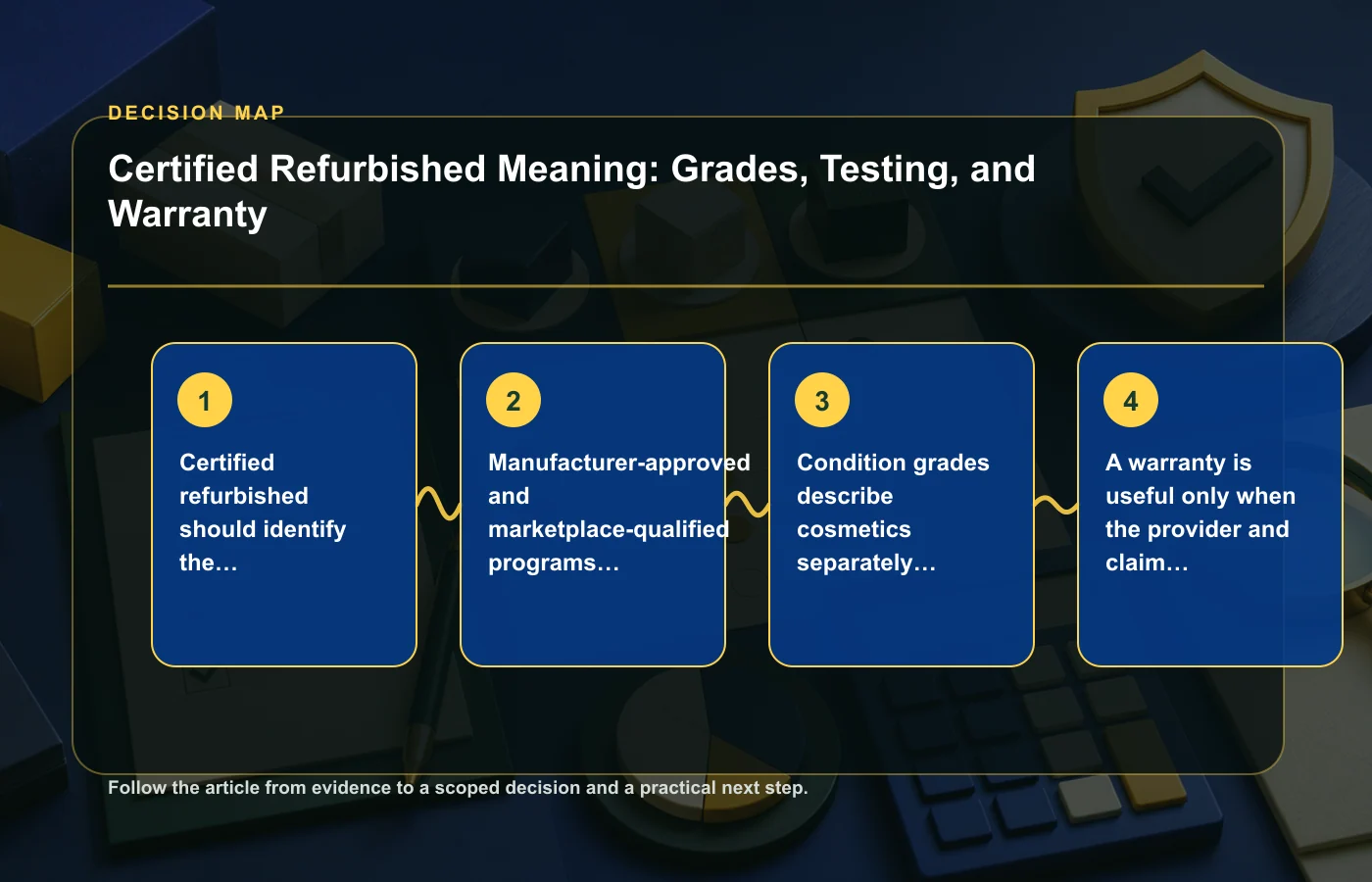
Start by identifying the certification program
The first question behind the certified refurbished meaning is not "Is this as good as new?" It is "Certified under which rules?" A certification is only as informative as the program that defines it. Look for a named program, an explanation of seller eligibility, and a condition policy that tells you what the refurbisher is expected to inspect or restore.
If the listing uses "certified" without making the program clear, do not fill in the missing details yourself. The safe comparison is between what is explicitly promised on the listing and what the program documentation actually says. A polished badge or prominent condition label does not substitute for a written scope.
What should be visible before purchase?
- The organization or marketplace behind the certification.
- The condition tier attached to the exact item.
- A description of testing or refurbishment requirements.
- The warranty provider and claim route, if a warranty is included.
- Any eligibility limits that depend on seller, geography, or product category.
If you are comparing several listings, record these items side by side. That prevents one seller's "certified refurbished" label from being treated as equivalent to another seller's differently defined program. For a broader framework on comparing condition labels, the buying guides section can help you keep the decision focused on verifiable terms rather than badges.
Manufacturer-approved and marketplace programs are different
A manufacturer-run refurbishment program and a marketplace-qualified program can both be legitimate, but they do not necessarily use the same inspection process, seller requirements, accessories policy, or warranty structure. The important point is not to rank the labels by name. It is to understand which party is responsible for each promise.
For example, one program may control the refurbishment process directly, while another may set eligibility rules for participating sellers. A buyer should therefore separate the product condition from the transaction structure. Ask who inspected the device, who sold it, who backs the warranty, and who you contact if the delivered item does not match the listing.
Compare responsibilities, not branding
A useful worksheet has four columns: refurbisher, seller, warranty provider, and return handler. If the same company occupies all four, the process may be easier to understand; if several parties are involved, that is not automatically a problem, but you should know where each responsibility starts and ends. If a price difference is part of the decision, check the historical offer separately with this price-history guide rather than assuming that a refurbished badge itself proves value.
Cosmetic grades do not describe functional testing
Terms such as "excellent," "very good," or "Grade A" often sound like complete quality scores. They are not unless the relevant program defines them that way. Cosmetic grade can tell you about visible wear while saying little about internal components, battery condition, thermal behavior, or the extent of functional testing.
eBay's condition structure illustrates the problem: different refurbished and open-box states are separately defined. The practical lesson is that appearance and function should be checked independently. A device can look clean and still have an issue that matters for your use; conversely, cosmetic marks do not necessarily tell you that a device performs poorly.
Turn the grade into concrete questions
- What cosmetic wear is allowed under this grade?
- Does the program state that core functions are tested?
- Are batteries or other wear components covered by a separate standard?
- Are missing or replacement accessories allowed?
- Does the exact listing add details beyond the generic program definition?
When a seller uses a grade that is not defined in the program terms, treat it as seller-specific language. Do not import a definition from a different marketplace or refurbisher just because the same letter or adjective is used.
Read the warranty as a process, not a headline
Warranty coverage can materially reduce transaction risk, but the word "warranty" is not enough. Before buying, identify who provides it, what failures are covered, how long the coverage lasts, and what you must do to make a claim. A long-looking coverage period is less useful if important exclusions or an impractical claim route apply.
Some marketplace refurbished programs include warranty protection, but the buyer still needs to check the current terms for the exact listing and location. Keep the return policy separate in your notes. A return window is mainly useful for an item that arrives wrong, damaged, or unsuitable; a warranty is meant to address covered problems that arise under its terms. They solve related but different risks.
Warranty questions worth answering in writing
- Who is the named warranty provider?
- When does coverage begin and end?
- What types of defects or failures are excluded?
- Who pays or arranges shipping if service is needed?
- Is repair, replacement, or another remedy described?
Save the listing and warranty terms at the time of purchase. Programs and seller pages can change, and your decision should be based on the terms attached to the transaction you actually made.
Verify accessories, serial status, and support eligibility
A refurbished device is only a good fit if the delivered package contains what you need to use it. Check the listing for the charger, cables, adapters, or other required accessories rather than assuming they match a new retail box. If an accessory is described as compatible rather than original, decide whether that matters for your use before buying.
For products where manufacturer support, activation, or serial-based service matters, confirm that the device can receive the support you expect. The source article does not establish a universal rule for every product category, so this is a verification step rather than a promise. The safest approach is to compare the listing, program rules, and manufacturer support information that apply to the exact item.
Make missing information a decision variable
If a seller cannot clearly confirm a required accessory or support condition, write that uncertainty into the comparison. A lower price may still be acceptable if the missing item is easy for you to replace, but the decision should be explicit. Do not treat an unspecified accessory as included or an unspecified support status as valid.
"Grade A" is not an industry-wide standard
One of the easiest mistakes in refurbished shopping is assuming that a familiar grade has a fixed meaning everywhere. "Grade A" should be treated as program- or seller-defined unless a specific policy gives it a clear definition. Another seller may use the same phrase for a different cosmetic threshold, test process, or accessory bundle.
This is why comparison should happen at the level of the exact listing. Match the same model and configuration, then compare the written condition standard, testing description, warranty, return terms, and included items. The label can help you navigate the catalog, but it should not carry more meaning than the documented rules give it.
If you are still deciding between broader condition categories, the renewed-versus-refurbished comparison explains why program definitions and transaction terms matter more than the wording alone.
A practical pre-purchase comparison
When two refurbished listings appear similar, compare them in a fixed order instead of letting the headline grade decide the outcome. First confirm that the model and configuration are actually equivalent. Then compare the condition definition, the party responsible for refurbishment, the listed accessories, and the warranty and return routes. Only after those points match closely does a price comparison become meaningful.
A simple decision note can prevent several common errors. Write down one must-have condition for the item, one uncertainty you are willing to accept, and one issue that would make you reject the listing. For one buyer, a missing original accessory may be unimportant; for another, support eligibility or a clearly documented battery standard may be essential. The point is to make the tradeoff explicit rather than assume the certification label resolves it.
- Match the item: same model, configuration, and relevant specifications.
- Match the condition: use the program's written definition rather than the grade name alone.
- Match the package: note which accessories are included and whether replacements are acceptable.
- Match the protection: compare return and warranty terms separately.
- Record uncertainty: do not turn an unanswered seller question into an assumed feature.
This sequence also makes it easier to compare a certified refurbished listing with a new, renewed, open-box, or seller-refurbished alternative. You are no longer comparing labels; you are comparing the parts of the transaction that affect usability and risk.
FAQ: Certified refurbished products
Does certified refurbished always mean manufacturer refurbished?
No. The source material distinguishes manufacturer-approved and marketplace-qualified programs. The important step is to identify the program behind the certification and who performed or controlled the refurbishment.
Is Grade A the same everywhere?
No universal definition is established by the source material. Treat Grade A as a seller- or program-specific term unless the applicable policy defines it clearly.
Is a warranty enough to make a refurbished purchase low risk?
Not by itself. Check the provider, coverage, exclusions, claim process, return rights, and the exact condition description. A warranty is one part of the transaction, not a substitute for verifying the item.
What should I save after ordering?
Keep the listing, condition description, warranty terms, order details, and any serial or accessory information relevant to the purchase. Those records make it easier to show what was promised if a problem appears.
How this page was prepared
Reviewed by My Deal Junction Standards Editor. Claims, terminology, and time-sensitive details were checked against the sources listed below and the page was last updated August 24, 2026.
AI-assisted tools supported research organization or drafting; editorial review remained responsible for source selection and the published conclusions.
Sources and verification
Primary and authoritative references used to verify this article: