
How to Check Price History Before You Buy
Price history is useful only when the past and current offers are truly comparable. Check the exact SKU, condition, bundle, seller, fulfillment terms, and reference period before calling a price a deal.
- Desk
- Buying Guides
- Checked
- Aug 14, 2026
- By
- My Deal Junction Buyer Desk
A price-history chart can help you judge whether today's offer is unusual, but it does not prove that the current price is a bargain. Historical prices are only useful when you are looking at the same item under comparable selling conditions. A different SKU, bundle, seller, condition, or fulfillment arrangement can make two numbers look comparable when they are not.
Amazon describes price-history context for some offers, including historical Featured Offer prices over recent periods. That can be a useful reference point, but it should be combined with a careful check of the exact listing. The objective is not to find the lowest number ever shown. It is to understand whether the current offer is attractive for the exact product and transaction you are considering.
| Price-history check | What must match | Why it matters |
|---|---|---|
| Product identity | Exact SKU or equivalent product identifier | Different variants can have different normal prices |
| Condition | New, renewed, refurbished, open-box, or other stated condition | Condition changes what is being sold |
| Bundle | Included accessories or package contents | A lower price may reflect a smaller bundle |
| Seller | The seller responsible for the offer | Seller terms and transaction risk can differ |
| Fulfillment | The relevant delivery or fulfillment arrangement | The offer may not be equivalent if fulfillment changes |
| Comparison period | The time window shown by the history tool or reference price | A short or unclear period can distort what "usual" means |
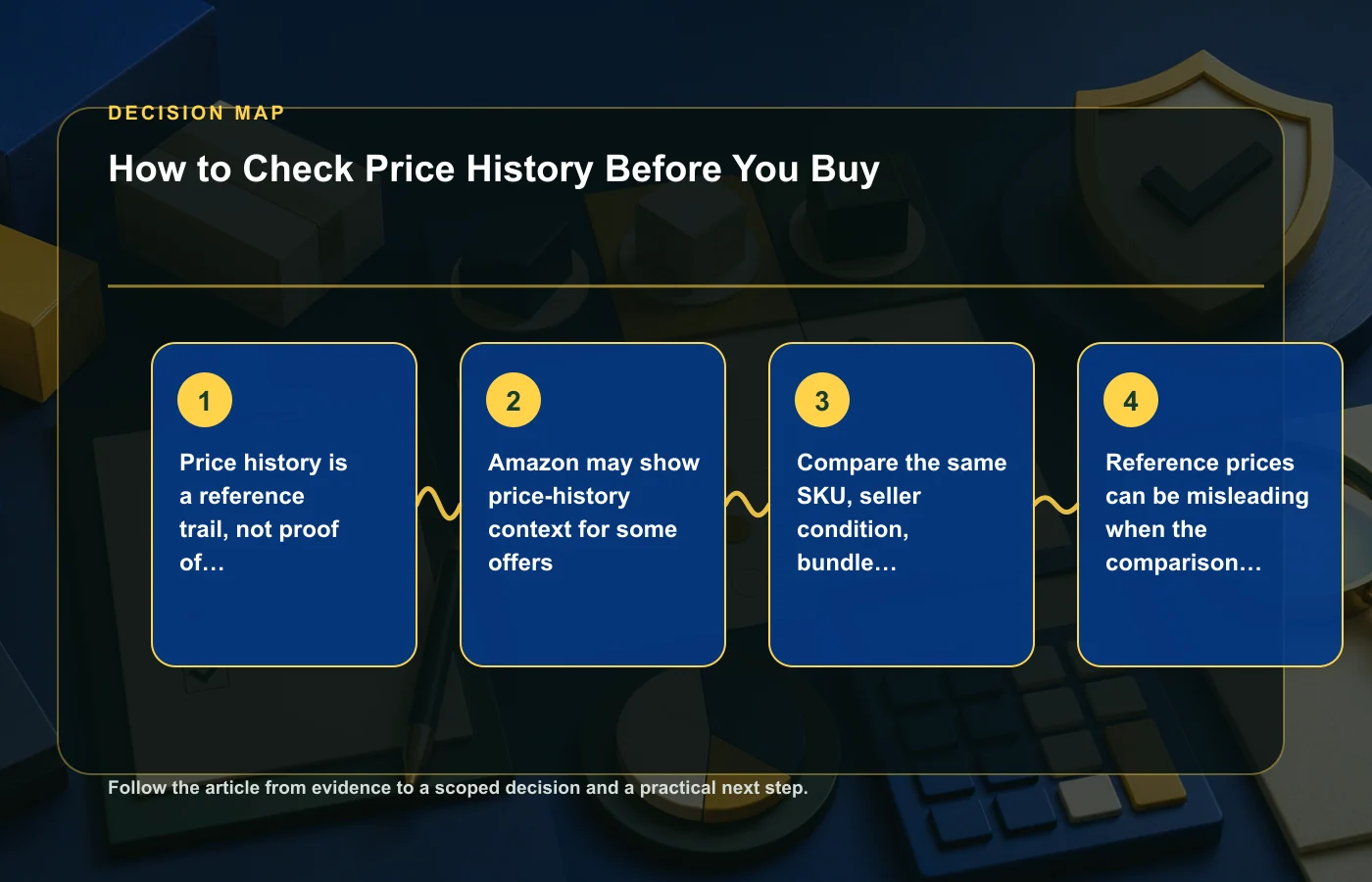
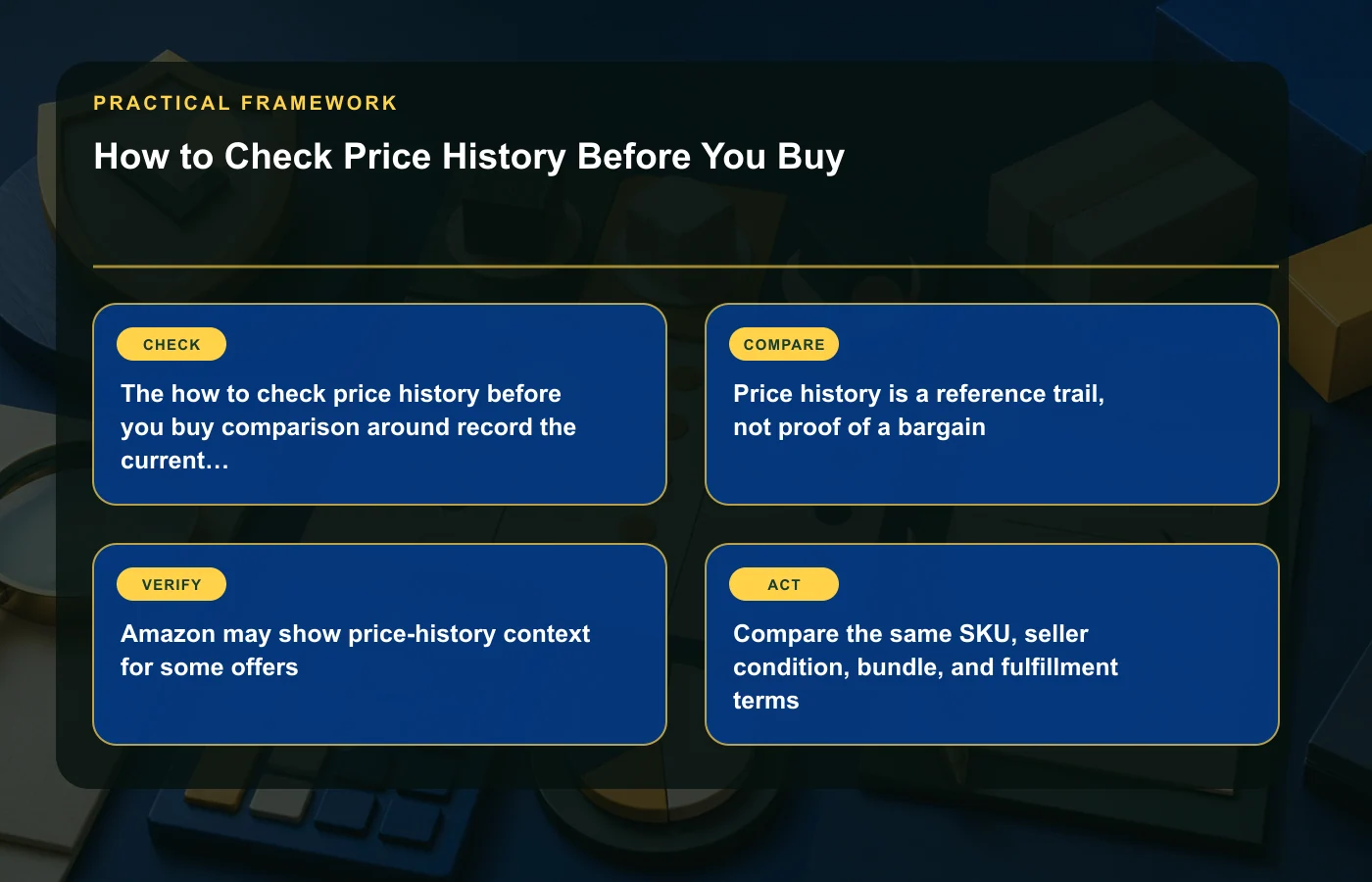
Use price history as a reference trail, not proof of a bargain
A historical chart answers a narrow question: what prices has this tracked offer or item shown during the period covered by the tool? It does not answer whether the product is good, whether the seller is suitable, or whether the current offer is the right purchase for you. Those are separate decisions.
Look for context, not a magic threshold
A useful price-history check asks whether the current offer sits within a familiar range, appears unusually high, or is lower than the recent reference points available to you. Avoid turning that observation into a universal rule such as "buy whenever the chart reaches its minimum." The historical minimum may have occurred under different conditions, and the future price is unknowable.
Price history is best used to challenge promotional framing. If a page suggests that an offer is exceptional, the history can provide context. If the history is unavailable or does not clearly correspond to the same listing, label the comparison as incomplete rather than treating a crossed-out number as evidence.
For more general purchase-decision material, the site's buying guides collect related checks for condition, compatibility, and transaction terms.
Amazon price-history context is useful only when you understand what it tracks
Amazon describes a price-history feature that can show historical Featured Offer prices for some items over recent periods. That can reduce the need to rely only on the current reference price, but it still requires interpretation. The important question is which offer and period the history represents.
Do not assume every Amazon listing has the same history context
The source material for this article says the feature may be available for some offers, so treat its availability as listing-specific. If the history is shown, read the labels and the period it covers. If it is not shown, do not infer a historical trend from the current discount badge or list price.
Keep the price-history information separate from product-quality claims. A favorable historical price says nothing by itself about condition, warranty, seller reliability, fit, or performance. Those details still need their own verification.
Compare the same SKU, condition, bundle, seller, and fulfillment terms
This is the most important quality-control step. A price comparison is only as good as the identity match behind it. Before you conclude that today's offer is lower or higher than a prior one, confirm that the comparison refers to the same product variant and a sufficiently equivalent transaction.
Use a five-part identity check
- SKU or model identity: verify that the product itself is the same variant.
- Condition: do not mix new, renewed, refurbished, open-box, or used offers.
- Bundle: check whether accessories or package contents changed.
- Seller: note whether the seller changed between the offers you are comparing.
- Fulfillment terms: confirm whether the delivery or fulfillment arrangement affects the transaction.
If one of those elements differs, treat the price difference as potentially explained by the changed offer rather than automatically calling it a discount. When condition is the variable, the site's refurbished, open-box, and used guide explains what else to verify before comparing value.
Reference prices can mislead when the comparison period is unclear
A crossed-out reference price is easy to read as "the normal price," even when the basis for that comparison is not obvious. FTC deceptive-pricing guidance is a useful reminder that reference-price claims need context; a higher crossed-out number, by itself, is not enough evidence that the current offer is unusually low.
Ask what the reference price actually refers to
- Is it a prior price for the same item?
- Does the page explain the time period?
- Is the comparison tied to the same condition and bundle?
- Is the reference based on the same seller or offer type?
- Can you corroborate the claim with available price history?
If the basis remains unclear, use the current price as the price you can actually transact at and treat the reference as promotional context rather than proof of savings. The site's five-minute sale check applies the same idea to broader sale claims.
Record the current offer before a major sale event
If you are waiting for a major promotion, create your own reference point before it begins. Record the exact product identity, condition, bundle, seller, fulfillment terms, and current offer. This gives you a clean before-and-after comparison when the sale starts.
Capture enough context to make the later comparison valid
A price alone is not enough. If the bundle changes during the sale, or a different seller becomes the featured offer, the later number may describe a different transaction. Your note should therefore preserve the details that make the offer comparable.
- Product or SKU identifier
- Stated condition
- Included bundle or accessories
- Seller
- Fulfillment or delivery context
- Displayed price and the date you recorded it
The purpose is not to build a permanent database. A simple note or screenshot-level record can prevent a sale badge from resetting your memory of what the item cost immediately before the event.
Turn price history into a purchase decision
Recognize the common reasons two historical prices are not comparable
A price-history graph can look precise while hiding a change in the underlying offer. Before you use a past point as a benchmark, ask what could have changed between then and now. The most obvious differences are model and condition, but bundles and seller terms can be just as important. A past offer that included fewer accessories is not an apples-to-apples benchmark for a larger current bundle; a lower-condition item is not a valid benchmark for a new one.
Variant changes can hide behind one product family
Products are often sold in multiple sizes, capacities, colors, generations, or configurations. This article's source does not provide rules for how any specific marketplace groups those variants, so the safe practice is to verify the exact identifier yourself. If the historical tool does not make that identity clear, reduce your confidence in the comparison.
Seller and fulfillment changes can alter transaction value
Two offers for the same physical product may still carry different seller, return, warranty, or fulfillment conditions. Price history should therefore be treated as one evidence stream rather than a complete value score. If the current offer is slightly different, write down the difference and decide whether it explains part of the price gap.
| Mismatch | What it can change | How to handle it |
|---|---|---|
| Different variant | The product itself | Do not use the old point as a direct benchmark |
| Different condition | Wear, inspection status, warranty, or return expectations | Compare within the same stated condition where possible |
| Different bundle | Included accessories and effective value | Normalize the comparison or keep the offers separate |
| Different seller or fulfillment | Transaction terms and risk | Review the exact seller and policy context |
This discipline is especially important when a chart shows a dramatic low. The larger the apparent bargain, the more worthwhile it is to verify that the old and current offers are genuinely the same thing.
Build a decision from price history, not around it
Price history should answer one part of the purchase decision: whether the present offer looks ordinary or unusual relative to the available history. After that, return to the product itself. Confirm that it is the right model, that the condition is acceptable, that the bundle contains what you need, and that seller, warranty, return, and fulfillment terms are suitable.
A low historical price on the wrong configuration is not a good deal. Likewise, paying more than the historical minimum can still be rational if the current offer has the condition, seller, bundle, or timing that fits your needs. The goal is not to win the chart; it is to make a defensible purchase.
Give more weight to the clearest evidence
When several price references disagree, favor the one you can tie most clearly to the exact item and offer conditions. A long history for an uncertain variant is less useful than a shorter history you can confidently match to the SKU you intend to buy. Likewise, an unexplained reference price deserves less weight than a documented historical series.
Keep the conclusion proportionate to the evidence. If the data only supports "this offer is lower than several recent comparable points," say that. Do not escalate it into "best price" or "guaranteed bargain" unless the available evidence truly establishes that claim.
Price-history checklist
- Confirm the exact product or SKU.
- Check the stated condition.
- Verify bundle contents and accessories.
- Note the seller and fulfillment terms.
- Review the available price-history period and what it tracks.
- Do not treat a reference price as proof of savings without context.
- Record the current offer before a major sale if you plan to wait.
- Recheck warranty, return, and other transaction terms before purchase.
Recheck the live offer immediately before purchase, because a valid historical comparison depends on the transaction that is actually available to you.
FAQ
Does a price-history low mean I should buy immediately?
No. A low historical price is context, not a purchase command. First confirm that the history refers to the same product, condition, bundle, seller context, and other terms that matter to you.
Can I use Amazon's price history to prove a discount is genuine?
It can provide useful historical context for some offers, but you still need to understand what the feature tracks and compare the exact listing. A historical chart does not replace checks on condition, bundle, seller, or transaction terms.
What should I save before a sale starts?
Save enough information to identify the exact offer later: the product or SKU, condition, bundle, seller, fulfillment context, displayed price, and the date of your note.
How this page was prepared
Reviewed by My Deal Junction Standards Editor. Claims, terminology, and time-sensitive details were checked against the sources listed below and the page was last updated August 14, 2026.
AI-assisted tools supported research organization or drafting; editorial review remained responsible for source selection and the published conclusions.
Sources and verification
Primary and authoritative references used to verify this article: