
Total Cost of Ownership: Calculate the Real Cost Before Buying
Buyer-focused guidance for total cost of ownership calculator, using Total cost of ownership starts after the and Separate one-time acquisition costs from recurring operating to verify fit, terms, and source-backed.
- Desk
- Buying Guides
- Checked
- Aug 19, 2026
- By
- My Deal Junction Buyer Desk

Total cost of ownership calculator is most useful when the comparison is tied to one buyer scenario rather than a universal 'best' label. In total cost of ownership, begin with total cost of ownership starts after the sticker price and verify any product, warranty, safety, condition, or seller claim before relying on it. Total cost of ownership is a planning model rather than a regulated label; the calculation becomes useful when every cost uses the same time horizon and scenario; here, the narrow implication for total cost of ownership is the issue described by total cost of ownership starts after the sticker price. For this total cost of ownership guide, no price, discount, stock status, star rating, test result, or personal ownership experience is invented.
| Decision input | Compare like with like | Recheck before buying |
|---|---|---|
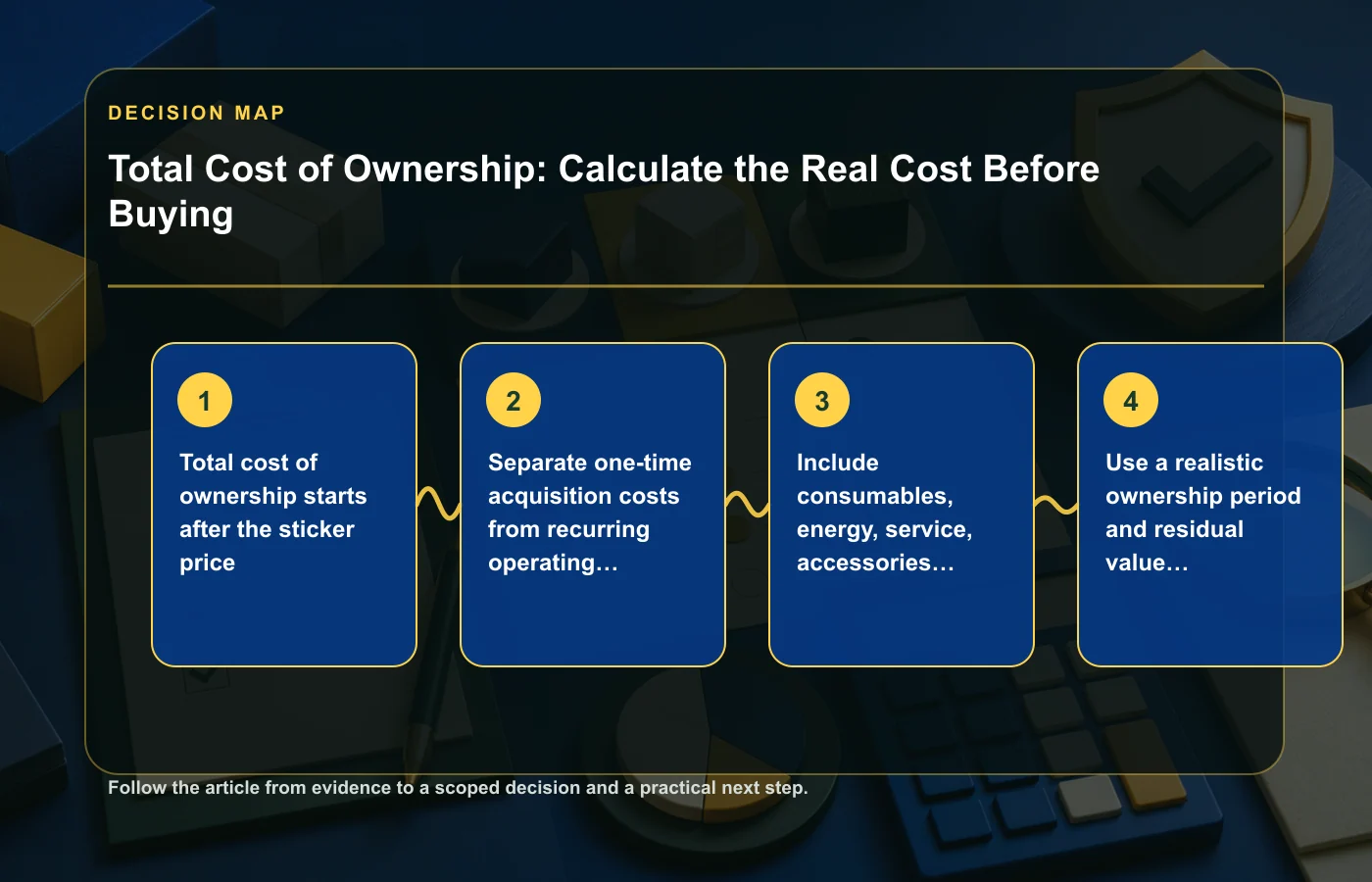
| Total cost of ownership starts after the sticker price | same model or plan | manufacturer or program |
| Separate one-time acquisition costs from recurring operating costs | same condition and bundle | seller and warranty terms |
| Include consumables, energy, service, accessories, and required subscriptions | same ownership period | official safety or policy source |
Total cost of ownership starts after the sticker price
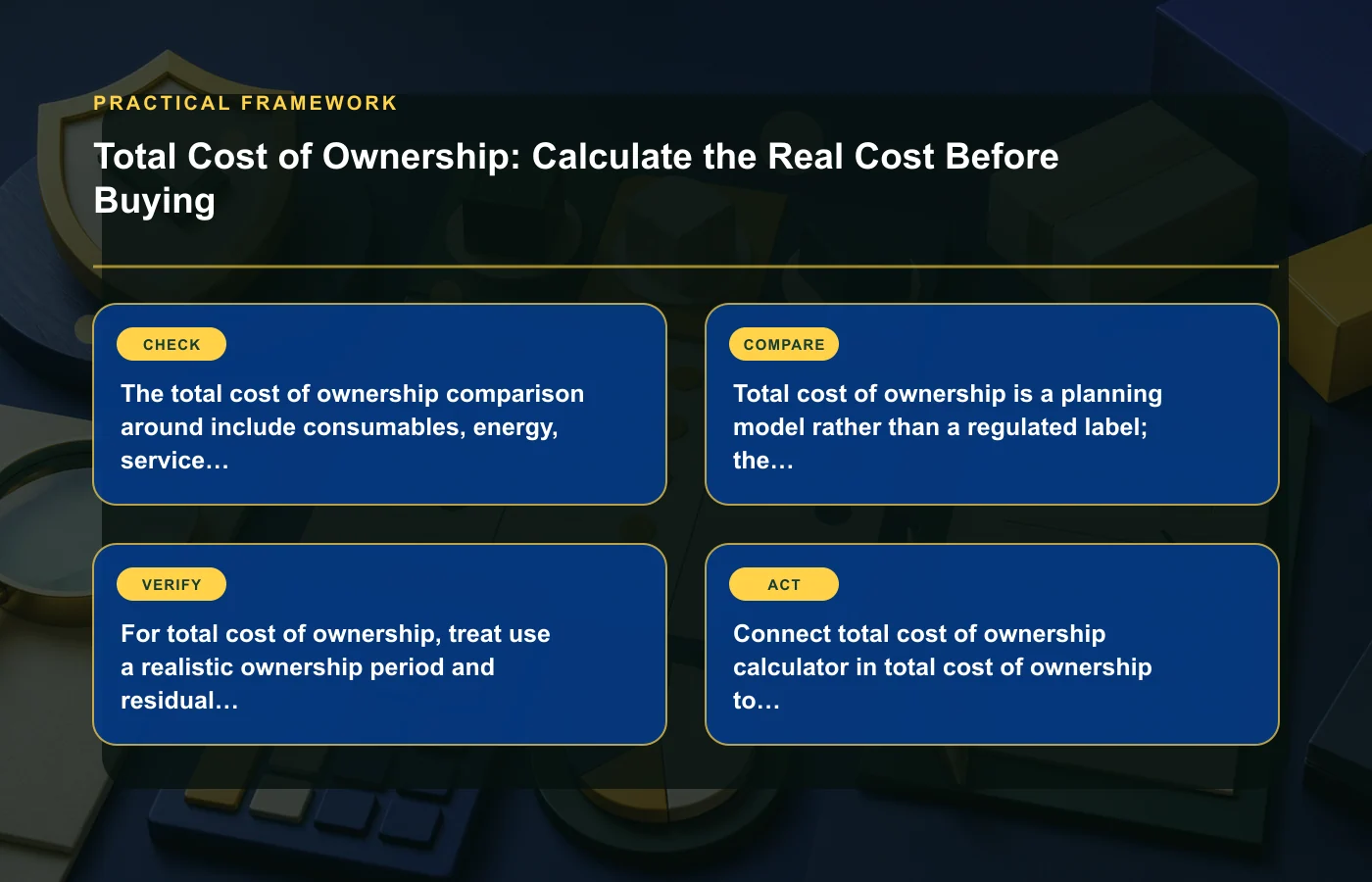
Total cost of ownership is a planning model rather than a regulated label; the calculation becomes useful when every cost uses the same time horizon and scenario; here, the narrow implication for total cost of ownership is the issue described by total cost of ownership starts after the sticker price. For total cost of ownership, treat total cost of ownership starts after the sticker price as a buying criterion only if it changes the compatibility constraint for the intended scenario. Connect total cost of ownership calculator in total cost of ownership to a verifiable source: the manufacturer for specifications, the seller for transaction terms, a regulator for safety notices, or a recognized standard for total cost of ownership calculator when it actually applies. If total cost of ownership starts after the sticker price cannot be confirmed before the total cost of ownership purchase, write down the uncertainty alongside the compatibility constraint instead of filling the gap with a rating, review anecdote, or assumed discount. That keeps total cost of ownership buyer-focused without inventing product performance.
Use total cost of ownership starts after the sticker price to define a disqualifier for total cost of ownership: a size, connector, power requirement, operating limit, warranty term, return condition, or seller detail that would make the option unsuitable. For total cost of ownership calculator in total cost of ownership, verify that disqualifier using the responsible source and preserve the listing or policy text relevant to total cost of ownership calculator at the time of purchase. A favorable feature in total cost of ownership should not outweigh an incompatible compatibility constraint; likewise, a promotional badge should not substitute for checking total cost of ownership starts after the sticker price. The total cost of ownership comparison around total cost of ownership starts after the sticker price is about fit and transaction risk, not a promise that one item is universally best. A connected buyer path from total cost of ownership is how to check price history before you buy; use it only when that category, condition, or ownership-cost issue actually changes the purchase scenario.
Separate one-time acquisition costs from recurring operating costs
Recurring costs such as consumables, service, energy, subscriptions, storage, or accessories can be more important than the initial discount; here, the narrow implication for total cost of ownership is the issue described by separate one-time acquisition costs from recurring operating costs. For total cost of ownership, treat separate one-time acquisition costs from recurring operating costs as a buying criterion only if it changes the seller term for the intended scenario. Connect total cost of ownership calculator in total cost of ownership to a verifiable source: the manufacturer for specifications, the seller for transaction terms, a regulator for safety notices, or a recognized standard for tco total cost of ownership calculator when it actually applies. If separate one-time acquisition costs from recurring operating costs cannot be confirmed before the total cost of ownership purchase, write down the uncertainty alongside the seller term instead of filling the gap with a rating, review anecdote, or assumed discount. That keeps total cost of ownership buyer-focused without inventing product performance.
Use separate one-time acquisition costs from recurring operating costs to define a disqualifier for total cost of ownership: a size, connector, power requirement, operating limit, warranty term, return condition, or seller detail that would make the option unsuitable. For total cost of ownership calculator in total cost of ownership, verify that disqualifier using the responsible source and preserve the listing or policy text relevant to tco total cost of ownership calculator at the time of purchase. A favorable feature in total cost of ownership should not outweigh an incompatible seller term; likewise, a promotional badge should not substitute for checking separate one-time acquisition costs from recurring operating costs. The total cost of ownership comparison around separate one-time acquisition costs from recurring operating costs is about fit and transaction risk, not a promise that one item is universally best. A connected buyer path from total cost of ownership is refurbished vs open box vs used what to verify; use it only when that category, condition, or ownership-cost issue actually changes the purchase scenario.
Include consumables, energy, service, accessories, and required subscriptions
Warranty and expected replacement risk should be represented as assumptions rather than guaranteed future costs; for total cost of ownership, that point is relevant specifically to include consumables, energy, service, accessories, and required subscriptions. For total cost of ownership, treat include consumables, energy, service, accessories, and required subscriptions as a buying criterion only if it changes the ownership condition for the intended scenario. Connect total cost of ownership calculator in total cost of ownership to a verifiable source: the manufacturer for specifications, the seller for transaction terms, a regulator for safety notices, or a recognized standard for total cost of ownership (tco) calculator when it actually applies. If include consumables, energy, service, accessories, and required subscriptions cannot be confirmed before the total cost of ownership purchase, write down the uncertainty alongside the ownership condition instead of filling the gap with a rating, review anecdote, or assumed discount. That keeps total cost of ownership buyer-focused without inventing product performance.
Use include consumables, energy, service, accessories, and required subscriptions to define a disqualifier for total cost of ownership: a size, connector, power requirement, operating limit, warranty term, return condition, or seller detail that would make the option unsuitable. For total cost of ownership calculator in total cost of ownership, verify that disqualifier using the responsible source and preserve the listing or policy text relevant to total cost of ownership (tco) calculator at the time of purchase. A favorable feature in total cost of ownership should not outweigh an incompatible ownership condition; likewise, a promotional badge should not substitute for checking include consumables, energy, service, accessories, and required subscriptions. The total cost of ownership comparison around include consumables, energy, service, accessories, and required subscriptions is about fit and transaction risk, not a promise that one item is universally best.
Use a realistic ownership period and residual value assumption
Total cost of ownership is a planning model rather than a regulated label; the calculation becomes useful when every cost uses the same time horizon and scenario, which matters in this total cost of ownership discussion when considering use a realistic ownership period and residual value assumption. For total cost of ownership, treat use a realistic ownership period and residual value assumption as a buying criterion only if it changes the intended use for the intended scenario. Connect total cost of ownership calculator in total cost of ownership to a verifiable source: the manufacturer for specifications, the seller for transaction terms, a regulator for safety notices, or a recognized standard for total cost of ownership calculator excel template when it actually applies. If use a realistic ownership period and residual value assumption cannot be confirmed before the total cost of ownership purchase, write down the uncertainty alongside the intended use instead of filling the gap with a rating, review anecdote, or assumed discount. That keeps total cost of ownership buyer-focused without inventing product performance.
Use use a realistic ownership period and residual value assumption to define a disqualifier for total cost of ownership: a size, connector, power requirement, operating limit, warranty term, return condition, or seller detail that would make the option unsuitable. For total cost of ownership calculator in total cost of ownership, verify that disqualifier using the responsible source and preserve the listing or policy text relevant to total cost of ownership calculator excel template at the time of purchase. A favorable feature in total cost of ownership should not outweigh an incompatible intended use; likewise, a promotional badge should not substitute for checking use a realistic ownership period and residual value assumption. The total cost of ownership comparison around use a realistic ownership period and residual value assumption is about fit and transaction risk, not a promise that one item is universally best.
Discounts matter only if the underlying configuration is equivalent
Recurring costs such as consumables, service, energy, subscriptions, storage, or accessories can be more important than the initial discount; in total cost of ownership, use that fact only for the question of discounts matter only if the underlying configuration is equivalent. For total cost of ownership, treat discounts matter only if the underlying configuration is equivalent as a buying criterion only if it changes the failure cost for the intended scenario. Connect total cost of ownership calculator in total cost of ownership to a verifiable source: the manufacturer for specifications, the seller for transaction terms, a regulator for safety notices, or a recognized standard for total cost of ownership tco calculator when it actually applies. If discounts matter only if the underlying configuration is equivalent cannot be confirmed before the total cost of ownership purchase, write down the uncertainty alongside the failure cost instead of filling the gap with a rating, review anecdote, or assumed discount. That keeps total cost of ownership buyer-focused without inventing product performance.
Use discounts matter only if the underlying configuration is equivalent to define a disqualifier for total cost of ownership: a size, connector, power requirement, operating limit, warranty term, return condition, or seller detail that would make the option unsuitable. For total cost of ownership calculator in total cost of ownership, verify that disqualifier using the responsible source and preserve the listing or policy text relevant to total cost of ownership tco calculator at the time of purchase. A favorable feature in total cost of ownership should not outweigh an incompatible failure cost; likewise, a promotional badge should not substitute for checking discounts matter only if the underlying configuration is equivalent. The total cost of ownership comparison around discounts matter only if the underlying configuration is equivalent is about fit and transaction risk, not a promise that one item is universally best. For the total cost of ownership purchase decision, renewed vs refurbished condition warranty and value compared covers a related buyer check; verify that page's exact listing and current terms independently before applying it.
Run a base, low, and high case when future costs are uncertain
Warranty and expected replacement risk should be represented as assumptions rather than guaranteed future costs; here, the narrow implication for total cost of ownership is the issue described by run a base, low, and high case when future costs are uncertain. For total cost of ownership, treat run a base, low, and high case when future costs are uncertain as a buying criterion only if it changes the compatibility constraint for the intended scenario. Connect total cost of ownership calculator in total cost of ownership to a verifiable source: the manufacturer for specifications, the seller for transaction terms, a regulator for safety notices, or a recognized standard for total cost of ownership calculator when it actually applies. If run a base, low, and high case when future costs are uncertain cannot be confirmed before the total cost of ownership purchase, write down the uncertainty alongside the compatibility constraint instead of filling the gap with a rating, review anecdote, or assumed discount. That keeps total cost of ownership buyer-focused without inventing product performance.
Use run a base, low, and high case when future costs are uncertain to define a disqualifier for total cost of ownership: a size, connector, power requirement, operating limit, warranty term, return condition, or seller detail that would make the option unsuitable. For total cost of ownership calculator in total cost of ownership, verify that disqualifier using the responsible source and preserve the listing or policy text relevant to total cost of ownership calculator at the time of purchase. A favorable feature in total cost of ownership should not outweigh an incompatible compatibility constraint; likewise, a promotional badge should not substitute for checking run a base, low, and high case when future costs are uncertain. The total cost of ownership comparison around run a base, low, and high case when future costs are uncertain is about fit and transaction risk, not a promise that one item is universally best.
How this page was prepared
Reviewed by My Deal Junction Standards Editor. Claims, terminology, and time-sensitive details were checked against the sources listed below and the page was last updated August 19, 2026.
AI-assisted tools supported research organization or drafting; editorial review remained responsible for source selection and the published conclusions.
Sources and verification
Primary and authoritative references used to verify this article: