
Renewed vs. Refurbished: Condition, Warranty, and Value
Renewed and refurbished are program labels, not universal quality grades. Compare the exact condition definition, inspection process, warranty, returns, accessories, and seller before judging value.
- Desk
- Buying Guides
- Checked
- Aug 10, 2026
- By
- My Deal Junction Buyer Desk
"Renewed" and "refurbished" can sound like standardized quality grades, but they are better treated as program or seller labels that need their own definitions. The useful comparison is not the word printed beside the product. It is who inspected the item, what condition standard applies, what "working" means in that program, which accessories are included, who provides the warranty, what the return terms are, and who is actually selling the item.
Current eBay condition definitions distinguish among open-box, certified-refurbished, seller-refurbished, and graded refurbished states. That is a good illustration of why labels cannot be interpreted in isolation. Different programs can use different qualification rules. Before buying, read the exact listing and the program terms that apply to that specific offer.
| Buyer check | What to verify | Why it matters |
|---|---|---|
| Program label | How the marketplace, manufacturer, or seller defines renewed/refurbished condition | The label is not a universal grade |
| Inspection | Who inspected or restored the item and what the program says was checked | "Working" can mean different things under different programs |
| Warranty | Provider, coverage, duration, and service process | Warranty protection may matter more than the label itself |
| Return terms | Return window and seller or program conditions | A clearer return path can reduce transaction risk |
| Accessories and cosmetics | What is included and what cosmetic standard applies | Equivalent labels can still describe different bundles or appearance |
| Seller identity | Who is responsible for the transaction | Seller terms change the risk profile |
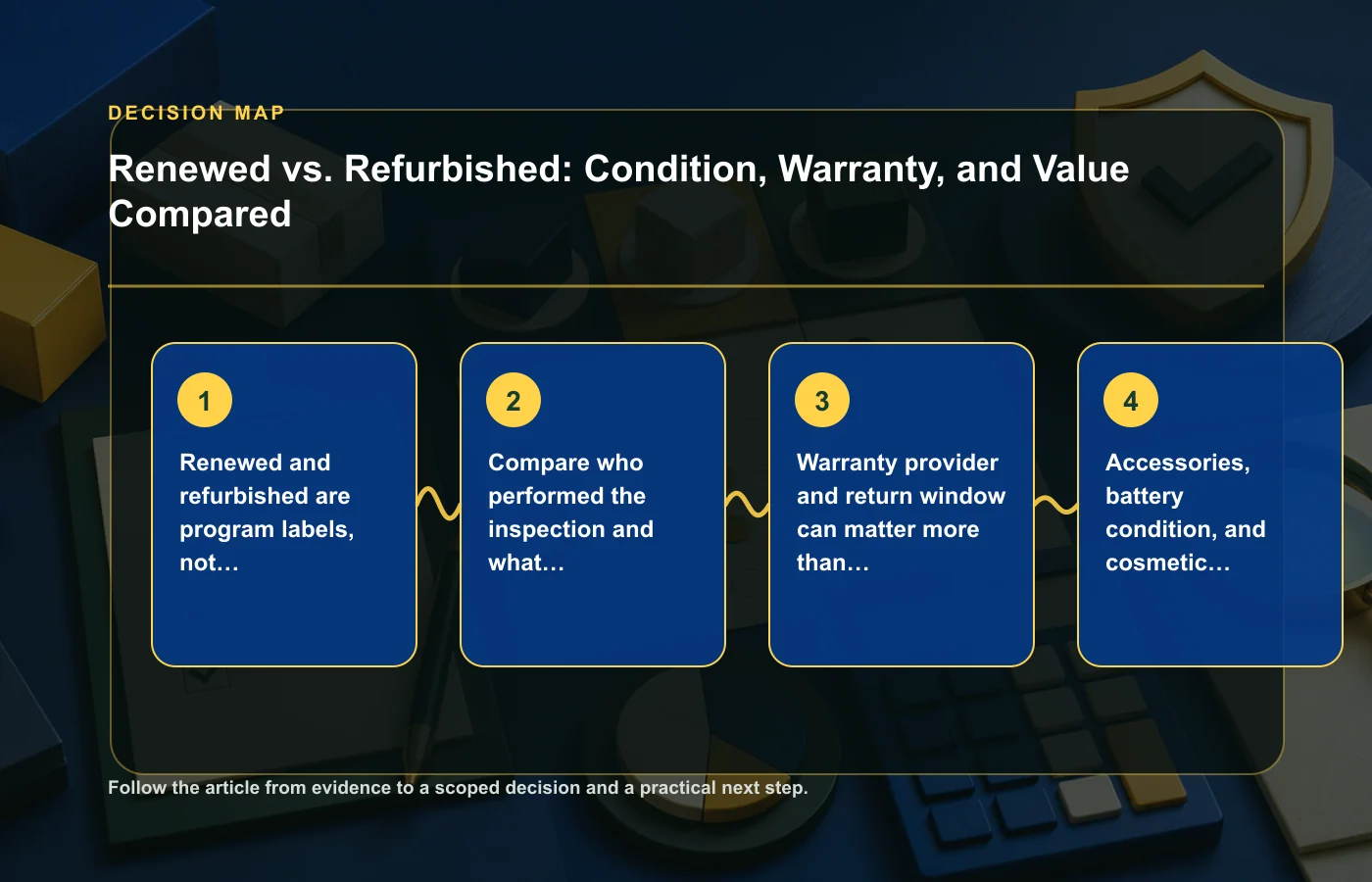
Renewed and refurbished are program labels, not universal grades
The first task is to identify whose definition you are reading. A marketplace program, a manufacturer program, and an independent seller may all use similar words while attaching different requirements to them. That means a comparison such as "renewed is better than refurbished" is too broad to be reliable without the underlying program rules.
Read the condition definition before the marketing copy
Start with the formal condition description for the exact listing. eBay's current definitions, for example, distinguish open-box, certified-refurbished, seller-refurbished, and graded refurbished conditions. The important lesson is not that one of those labels is universally best. It is that condition terminology is program-specific.
- Identify the program or seller applying the label.
- Read how that program defines the condition.
- Check whether inspection or restoration requirements are described.
- Confirm what cosmetic condition the definition permits.
- Keep the listing's actual terms with the condition label.
If you are comparing these categories with other non-new options, the site's refurbished vs. open-box vs. used guide expands the condition-checking framework.
Compare who performed the inspection and what "working" means
A refurbished item has usually passed through some kind of inspection or restoration process, but the source and scope of that process matter. Do not treat "inspected" as a complete description. Ask who performed the work and what the program says the item must do to qualify.
Separate the inspector from the seller
The party that sells the item may or may not be the same party that inspected or refurbished it. That distinction is useful because it tells you where to look for evidence. The listing should identify the seller, while the program terms or condition definition should explain the qualification standard. If those pieces are unclear, record the uncertainty rather than assuming a manufacturer-level process.
Translate "working" into specific checks
A broad statement that an item works does not necessarily tell you about battery condition, cosmetic wear, included accessories, or every function you care about. Build your own list of critical functions and see whether the program definition or listing addresses them. If a requirement is essential and not covered by the available terms, treat it as an unresolved purchase risk.
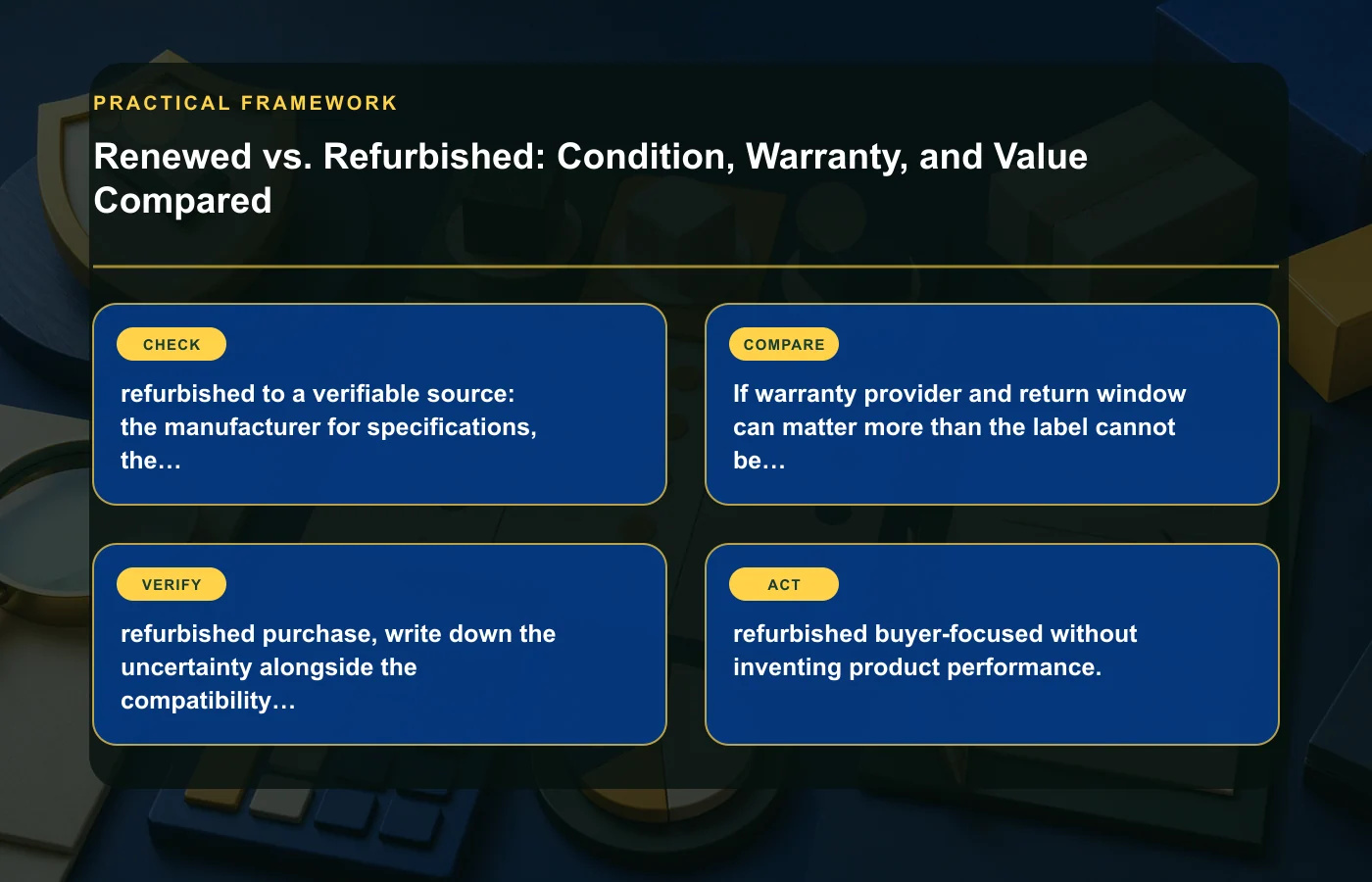
Warranty provider and return window can matter more than the label
Two items with similar condition labels can present very different downside risk if their warranty and return terms differ. FTC warranty guidance emphasizes reading who provides the warranty, what it covers, how long it lasts, and what the consumer must do to obtain service. Those questions are more concrete than the renewed/refurbished label.
Read the warranty as a service path
- Provider: who is responsible for warranty service?
- Coverage: what problems are included or excluded?
- Duration: how long does the protection last?
- Procedure: what must you do to request service?
Then read the return policy separately. A return window is not the same thing as a warranty. One governs whether and how you can return the item under the seller's terms; the other governs covered service after purchase. Compare both for the exact listing.
Check accessories, battery condition, and cosmetic standards separately
Condition labels can bundle several ideas together, but buyers should unbundle them. Accessories, battery condition, and cosmetics answer different questions. A device can be functionally acceptable while having visible wear; it can look clean while including fewer accessories; or it can satisfy a program's general condition standard without answering the battery question that matters to you.
Use a separate line item for each source of value
| Area | Question to ask | Evidence to look for |
|---|---|---|
| Accessories | What is actually included? | Exact listing and bundle description |
| Battery | Does the program or seller state a battery condition standard? | Program terms or listing |
| Cosmetics | What wear is allowed? | Condition definition and listing |
| Function | What must operate for the item to qualify? | Inspection or program criteria |
Do not fill a missing battery or cosmetic detail with assumptions drawn from another program. If the exact offer does not state the condition you need, that is a reason to seek clarification or choose an offer with clearer terms.
Calculate the value gap against the exact new alternative
Renewed or refurbished value is not simply "discount versus new." First make sure the new and non-new offers are comparable: same model or configuration, equivalent required accessories, and sufficiently similar warranty and seller terms. Then identify what you are giving up—or gaining—in exchange for the price difference.
Compare the transaction, not only the product
The value gap can include condition, warranty provider, return rights, accessories, and seller identity. A lower purchase price may be attractive, but it should be weighed against any uncertainty you would not accept on a new item. Conversely, a well-defined program with clear protection can reduce some of the risk that the label alone might suggest.
The site's broader buying guides use the same principle: compare the complete purchase scenario rather than a single headline field.
Seller identity changes the risk profile of the transaction
The same condition label can appear across different sellers, so identify who is actually responsible for the offer. Seller identity affects where you verify the bundle, return terms, and other transaction details. It can also determine whether a marketplace or program protection applies in the way you expect.
Do a seller-and-program cross-check
- Identify the seller named on the exact listing.
- Identify the program or condition definition being used.
- Confirm whether the warranty provider is the seller, marketplace, manufacturer, or another party.
- Read the return terms for that transaction.
- Check that the accessories and stated condition match the comparison you are making.
If the seller changes, repeat the check even if the headline label stays the same. A familiar marketplace term does not make every seller's offer identical.
For a complementary check on promotional framing, see How to Tell If a Sale Is Real; condition value still needs to be evaluated separately from the size of a displayed discount.
Build an evidence hierarchy for the listing
When several pieces of copy describe the same item, give more weight to the information that is closest to the transaction. A generic category page may explain what a program normally requires, while the exact listing tells you which seller, bundle, condition, and terms apply to the unit you are considering. Use both, but do not let a broad program promise overwrite a narrower listing detail.
Separate four layers of evidence
- Program definition: what the marketplace or refurbishing program says the label means.
- Exact listing: the condition, seller, included accessories, and offer-specific statements.
- Warranty terms: who provides service and under what conditions.
- Return policy: the process and window that apply if the item is not acceptable.
If those layers conflict, resolve the conflict before purchasing. Do not assume the most favorable statement automatically controls. The safer approach is to identify which document actually governs the transaction and preserve the relevant terms when you buy.
Plan the arrival check before checkout
You can also decide in advance what you will verify when the item arrives, using only criteria that matter to your purchase. That may include confirming the model and accessories, comparing cosmetic condition with the listing, checking that the functions you depend on operate, and making sure you know how to use the warranty or return path if something is wrong. Planning this before purchase helps you use the available return window deliberately instead of discovering a missing accessory or unclear condition standard much later.
This is not a substitute for the seller's or program's inspection process. It is a buyer-side check that the delivered item matches the offer you evaluated.
When comparing several offers, put these evidence layers into the same columns for every seller. That makes missing information obvious. One listing may look cheaper until you notice that another includes clearer warranty coverage or a more complete accessory bundle. The table should expose those differences rather than reduce them to a single condition label.
Use a disqualifier list before deciding
A good renewed-versus-refurbished comparison ends with clear reasons to say no. Examples include an undefined condition standard, no answer to a critical battery or accessory question, a warranty path you would not be comfortable using, or return terms that do not match the risk you are taking.
Keep those disqualifiers separate from preferences. Cosmetic appearance may be a preference for one buyer and a hard requirement for another. The point is to decide that before seeing the price so that a large apparent saving does not persuade you to accept a condition you would normally reject.
Immediately before purchase, recheck the live listing, seller identity, condition description, warranty, and return policy. The comparison is only useful if it matches the offer you are actually accepting.
Save the relevant terms with your purchase record so you can refer back to the offer you evaluated if service or a return becomes necessary.
FAQ
Is renewed always better than refurbished?
No. The labels are program-specific rather than universal grades. Compare the underlying condition definition, inspection process, warranty, return terms, accessories, and seller for the exact offer.
What matters most when buying a refurbished item?
Start with the condition definition and inspection standard, then check warranty provider and coverage, return terms, included accessories, any stated battery or cosmetic standards, and seller identity.
Should I compare a renewed or refurbished price directly with new?
Only after confirming that the product configuration and required accessories are comparable. Then account for the differences in condition, warranty, return terms, seller, and any other transaction detail that affects value.
How this page was prepared
Reviewed by My Deal Junction Standards Editor. Claims, terminology, and time-sensitive details were checked against the sources listed below and the page was last updated August 10, 2026.
AI-assisted tools supported research organization or drafting; editorial review remained responsible for source selection and the published conclusions.
Sources and verification
Primary and authoritative references used to verify this article: