
Hiking Boots Buying Guide: Fit, Traction, Waterproofing
Fit hiking boots with your real socks and hiking conditions in mind. Compare heel hold, toe room, stiffness, traction, waterproofing, and ankle height against your routes and load.
- Desk
- Home & Lifestyle
- Checked
- Sep 21, 2026
- By
- My Deal Junction Buyer Desk
Hiking boots should be chosen around fit, terrain, load, climate, and trip duration, not a universal idea of the "best" boot. The same pair can feel appropriate on one route and wrong on another because heel hold, toe room, midsole stiffness, outsole design, waterproofing, and ankle height all interact with how and where you walk.
National Park Service hiking guidance emphasizes route conditions, weather, water, navigation, and terrain rather than endorsing a single boot type. That is a useful buyer principle: define the trip first, then choose footwear that fits the conditions and your feet.
| Fit factor | What to check | Why it matters |
|---|---|---|
| Overall fit | Boots with the socks you actually hike in | Thickness and foot volume change the fit |
| Heel hold | Movement while walking uphill | Excess lift can create friction and instability |
| Toe room | Space while walking downhill | Feet move forward under descent load |
| Midsole | Stiffness relative to terrain and pack load | Changes support and ground feel |
| Outsole | Pattern and rubber relative to terrain | Traction needs differ by surface |
| Waterproofing | Protection versus heat and drying needs | Weather resistance comes with tradeoffs |
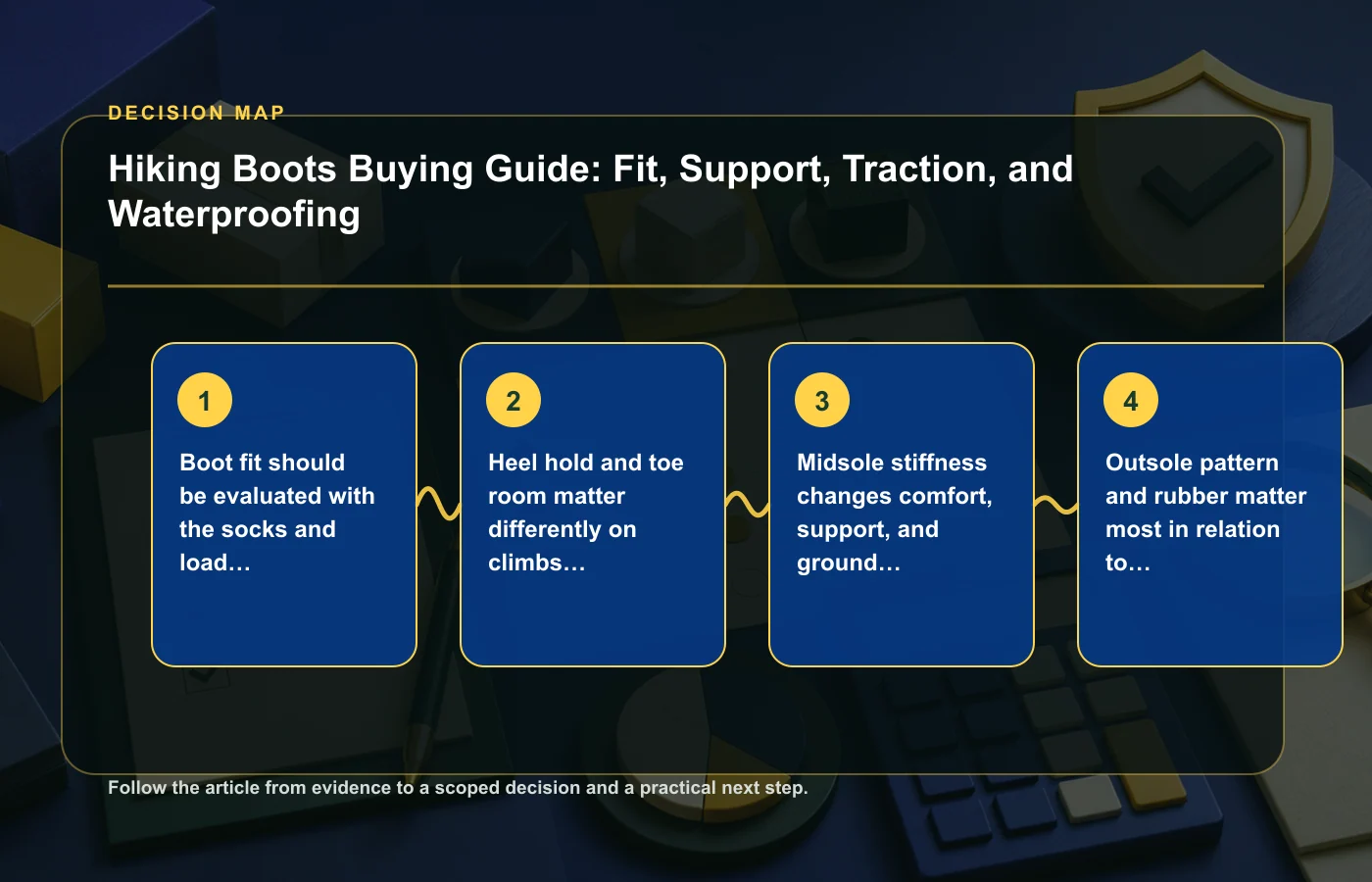
Evaluate boot fit with your real socks and load
A hiking-boot fitting should reproduce the conditions that matter. Wear the socks you plan to hike in rather than a random pair from the day you visit the store. If you regularly use a heavier pack, remember that your stance and foot movement can feel different under load.
The source material does not establish one universal amount of extra space or one sizing formula, so avoid choosing from a generic "size up" rule. Start with your normal size range, then judge the actual boot shape, width, volume, and hold on your feet.
Fit is more than length
- Does the heel stay secure without painful pressure?
- Can the forefoot spread naturally?
- Do the toes have room when moving downhill?
- Does the upper create a pressure point over the instep or ankle?
- Can the lacing adjust the boot securely without over-tightening?
Walk long enough during a fitting to notice pressure and movement, and use any incline surface the retailer provides. A boot that feels merely "snug" while standing still can behave differently once the foot is flexing.
Other outdoor purchase decisions also benefit from matching the product to the environment rather than the label. The home security camera guide is a different category but uses that same scenario-first logic.
Heel hold and toe room matter differently uphill and downhill
Climbing and descending load the foot differently. On an ascent, excessive heel movement can create rubbing and make the boot feel less secure. On a descent, the foot tends to move forward, making toe clearance more important.
A good fitting therefore includes both directions. Lace the boot as you expect to hike, walk up and down an incline, and notice where the foot moves. The goal is secure hold without creating concentrated pressure.
Use lacing as an adjustment, not a rescue
Different lacing tensions can refine heel hold or forefoot comfort, but lacing should not be used to force an unsuitable boot shape to fit. If your heel only stays down when the upper is painfully tight, or the toes reach the front on a descent, the underlying fit may be wrong.
Recheck the fit later in the day if possible because feet can feel different after hours of standing or walking. The buyer decision should be based on how the boot behaves in motion, not on whether the numerical size matches another pair you own.
Midsole stiffness changes support and ground feel
A stiff midsole can spread load and feel supportive on rough terrain or under a heavier pack, while a more flexible design can feel natural on easier ground. Neither is universally superior. The useful comparison is how the boot flexes relative to the terrain, load, and walking style you expect.
Try to distinguish sole stiffness from upper stiffness. A boot can have a supportive sole with a relatively flexible upper, or the reverse. Product descriptions may use broad terms such as "supportive" without explaining where the support comes from.
Ask what problem the stiffness solves
- Rocky or uneven terrain?
- Long days under a pack?
- Preference for more ground feel?
- Need for easier flex on simpler trails?
The source material does not prescribe one stiffness by pack weight or trail type, so use those questions as a fitting framework rather than a formula.
Outsole pattern and rubber matter in relation to terrain
Traction cannot be judged from an aggressive-looking tread alone. Lug shape, spacing, rubber compound, surface condition, and the way the sole contacts the ground all affect how a boot feels. A design that works well on loose soil may make different tradeoffs on rock, mud, roots, or smoother surfaces.
Start with the routes you hike most often. If they are usually dry and maintained, your needs may differ from a traveler who expects wet, muddy, or highly uneven ground. Read the manufacturer's intended-use description and compare it with the terrain rather than ranking soles by lug depth alone.
Traction is not a promise against slipping
No outsole eliminates the need for careful movement or appropriate route judgment. Weather and surface conditions can change quickly. Treat traction as one part of footwear fit for the terrain, not as a guarantee of safety.
The air purifier guide covers an unrelated product, but it illustrates the same buyer rule: performance specifications make sense only in the environment where the product will be used.
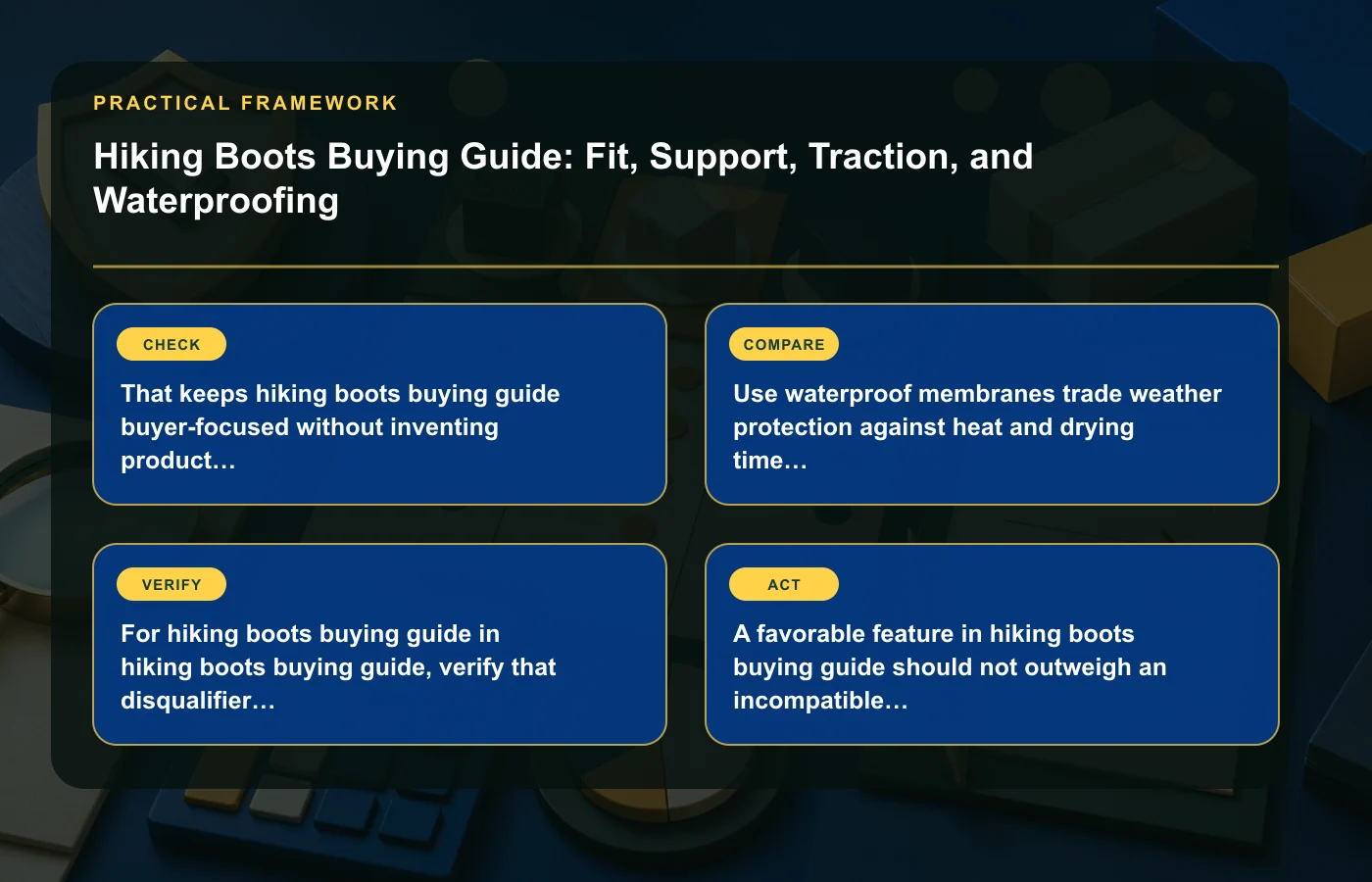
Waterproof membranes trade weather protection against heat and drying
A waterproof membrane can help keep external moisture out, but it can also change breathability and drying behavior. That tradeoff matters differently in cool, wet conditions than in hot or dry climates.
Do not treat "waterproof" as a complete climate solution. Water can still enter from the top of a boot, and footwear can become wet from sweat, deep crossings, or prolonged exposure. Think about how quickly the boot needs to dry between hiking days.
Choose around the expected weather pattern
- Frequent rain or wet vegetation.
- Warm weather and high sweat load.
- Multi-day trips where drying opportunities are limited.
- Stream crossings or conditions that can wet the boot internally.
- Cold conditions where wet feet create a different comfort problem.
If your hiking spans very different climates, one boot may not optimize every trip. That does not mean you need multiple pairs immediately; it means you should understand which conditions the chosen design prioritizes.
Ankle height does not automatically equal injury prevention
A higher cuff changes coverage, feel, debris protection, and how the upper interacts with the ankle. It should not be treated as automatic proof that the boot prevents injuries. The source material specifically warns against equating ankle height with guaranteed protection.
Fit, terrain, fatigue, load, movement, and many other factors affect hiking comfort and risk. Choose ankle height for the support feel, coverage, and mobility you prefer, and avoid turning a design feature into a medical promise.
Compare how the cuff moves with you
Walk on inclines and stairs if possible. A cuff can feel comfortable on flat ground yet press against the ankle during flexion. Check whether the collar creates rubbing, limits movement more than you want, or helps keep debris out in the terrain you expect.
For another fit-and-environment decision framework, the robot vacuum guide demonstrates why geometry and operating conditions often matter more than headline numbers.
Break-in should not be used to excuse a bad fit
Materials can soften and adapt with use, but a buyer should not assume that a painful pressure point, severe heel movement, or inadequate toe space will automatically disappear. The source material does not provide a universal break-in period, so avoid treating discomfort as an investment you must endure.
Use the return policy and retailer guidance to understand what testing is possible before committing the boots to a trail. Wear them indoors or under allowed conditions long enough to identify obvious fit problems. Once used outdoors, return options may change.
Separate normal adaptation from a fit warning
- Mild unfamiliar stiffness may change with use.
- Persistent toe contact on descents is a fit issue to investigate.
- Heel lift that requires painful lacing is a fit issue to investigate.
- Sharp pressure on a joint or bone should not be dismissed as "break-in."
This is a purchase-fit framework rather than medical advice. If foot pain or a medical condition affects footwear choices, professional guidance may be appropriate.
Build a boot shortlist from terrain and trip style
Before comparing prices, write down the hiking conditions the boots need to handle most often. Then give each candidate a simple pass/fail check for fit, terrain, weather, and load.
| Requirement | Your trip profile |
|---|---|
| Fit | Sock thickness, foot shape, heel hold, toe room |
| Terrain | Maintained trail, rock, mud, mixed surfaces |
| Load | Typical daypack or heavier pack |
| Climate | Wet/cool, warm/dry, mixed |
| Trip duration | Day hikes or repeated multi-day use |
| Tradeoff | More protection/support versus more flexibility/breathability |
A boot that passes the scenario test is worth comparing on price and transaction terms. A boot that fails a must-have fit condition should not return to the shortlist merely because it is discounted.
Use socks, insoles, and footbeds as part of the same fit system
A hiking boot is fitted around everything inside it. Sock thickness, footbed shape, and any insole you normally use can change internal volume, heel position, and toe space. If you plan to replace the supplied footbed, bring the intended insole to the fitting when practical rather than assuming it will occupy the same space.
This matters because a boot that feels secure with a thin sock can become cramped with a thicker hiking sock, while a higher-volume footbed can lift the heel or create pressure across the top of the foot. Evaluate the complete system you intend to wear on trail.
Repeat the incline test after every meaningful change
If you swap socks, footbeds, or lacing method, walk uphill and downhill again. Do not assume that a change which improves heel hold leaves toe room unchanged. Small adjustments can move the foot differently inside the boot.
Check the retailer's fitting and return conditions
Boot fit sometimes needs more than a few minutes of standing. Before purchase, read how the retailer handles indoor try-on, exchanges, and returns. That tells you how much time you have to compare sizes or widths without losing return eligibility.
Keep the packaging and avoid outdoor use until you are satisfied with the fit under the permitted testing conditions. A strong return process cannot fix every fit problem, but it gives you a practical way to reject a boot that looked right on paper and fails the movement test.
FAQ: Hiking boots
Should hiking boots feel tight when new?
They should feel secure, but the source material does not support a rule that painful tightness is desirable. Evaluate heel hold, forefoot space, toe room, and pressure points with your hiking socks while moving on inclines.
Are stiffer boots always more supportive?
Stiffness can change support and ground feel, but the right amount depends on terrain, load, and preference. A stiffer design is not automatically better for every hike.
Do I always need waterproof hiking boots?
No. Waterproof membranes trade weather protection against breathability and drying behavior. Choose based on the climate and trip pattern you actually expect.
Do high-cut boots prevent ankle injuries?
The source material does not support that automatic conclusion. Ankle height changes feel, coverage, and mobility, but it should not be treated as a guarantee of injury prevention.
How this page was prepared
Reviewed by My Deal Junction Standards Editor. Claims, terminology, and time-sensitive details were checked against the sources listed below and the page was last updated September 21, 2026.
AI-assisted tools supported research organization or drafting; editorial review remained responsible for source selection and the published conclusions.
Sources and verification
Primary and authoritative references used to verify this article: