
Unit Price Comparison: Formula, Examples, and Worksheet
Unit price is simple once every option uses the same measure. This guide shows how to normalize package sizes, recalculate promotions, and avoid misleading comparisons.
- Desk
- Buying Guides
- Checked
- Sep 4, 2026
- By
- My Deal Junction Buyer Desk
Unit price is one of the simplest ways to make package sizes comparable: divide the price by a consistent unit of measure. The arithmetic is easy; the buying decision is harder because packages may use different weights, volumes, counts, concentrations, or promotion structures. A useful unit price comparison normalizes those differences before deciding which option is cheaper.
NIST's 2025 Unit Pricing Guide describes unit pricing as a way to compare prices using a consistent unit across retail formats, including ecommerce. That principle is especially useful when shelf prices are visually misleading because one package is larger, a multi-buy changes the total paid, or a product must be diluted before use.
| Situation | Normalize to | Main check |
|---|---|---|
| Different package weights | Same weight unit | Convert before dividing |
| Different liquid sizes | Same volume unit | Do not mix ounces, liters, or other units without conversion |
| Count-based products | Price per item | Make sure items are genuinely comparable |
| Multi-buy offer | Total paid divided by total quantity | Include only units you must buy to get the offer |
| Concentrated product | Usable quantity when meaningfully different | Account for dilution or waste only when supported by the product directions |
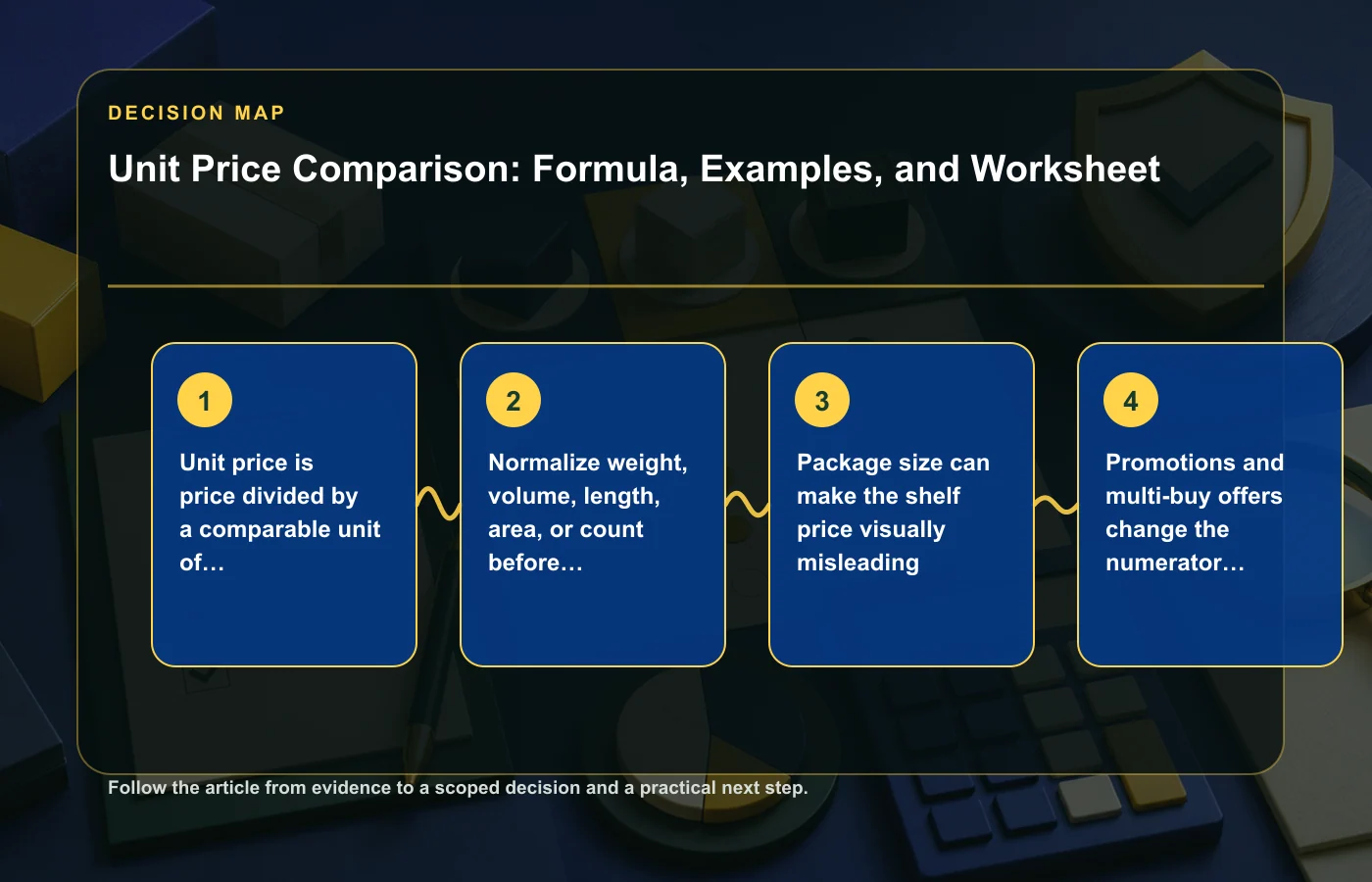
Unit price is price divided by a comparable unit
The basic formula is unit price = total price ÷ comparable quantity. If two products are sold in the same unit, you can divide directly. If one uses a different unit, convert first. The comparison only works when the denominator means the same thing on both sides.
For example, a larger package can have a higher shelf price while still costing less per unit. The reverse can also happen: a "value size" can look economical but have a higher unit price than a smaller package. Unit pricing removes the visual bias created by package size.
Build the calculation in a fixed order
- Write down the actual price you would pay.
- Write down the package quantity.
- Convert both options to the same unit.
- Divide price by quantity.
- Round both results to the same level of precision.
Do not mix condition or product quality into this arithmetic. Unit price answers "What does each comparable unit cost?" It does not prove that two products are equally useful, equally durable, or equally appropriate for your needs.
Normalize weight, volume, length, area, or count first
The denominator is the heart of the comparison. A bottle measured by volume should not be compared directly with another listing expressed in a different unit until the units are converted. The same rule applies to weight, length, area, and count.
NIST's guidance emphasizes consistent presentation because a unit price is only helpful when shoppers can compare like with like. If you are building your own worksheet, choose one standard unit for the category and use it every time.
Choose the unit that reflects how the product is bought
- Weight: useful for foods, materials, or other products sold by mass.
- Volume: useful for liquids and some household products.
- Count: useful when each item is reasonably equivalent.
- Length or area: useful when the usable material is measured that way.
If the package presents several measures, use the one that best matches actual consumption. A count can be misleading if individual items vary greatly in size; a weight measure can be more useful in that case. The source material does not define one universal denominator for every category, so the buyer still needs judgment.
Package size can make shelf price misleading
Human attention is drawn to the number printed most prominently. That is usually the total package price, not the cost per unit. A small package therefore can look cheaper even when it costs more for each comparable unit, while a larger package can feel expensive despite offering a lower unit price.
Unit price helps, but bigger is not automatically better. If a larger package creates spoilage, storage problems, or unused product, the theoretical per-unit saving may not become a real saving. Compare the quantity you are likely to use, not merely the largest package available.
Separate economic size from practical size
Ask two questions. First, which package has the lower unit price? Second, will I use the extra quantity before it becomes waste or inconvenience? A low unit price on unwanted quantity is not a better purchase.
If you are comparing condition-based products rather than consumables, the refurbished, open-box, and used guide shows why a lower price must still be matched to equivalent condition and terms.
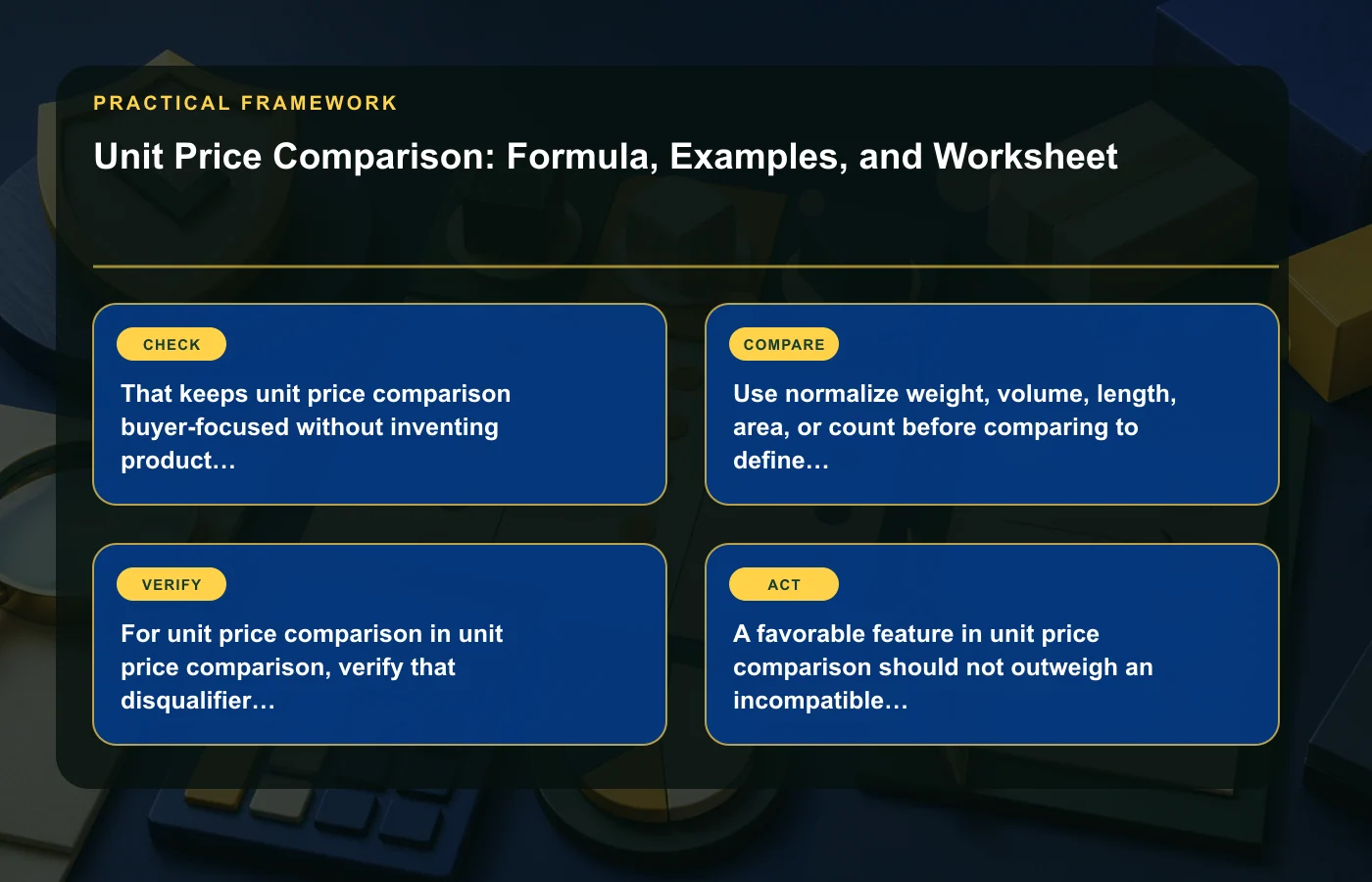
Promotions change the numerator, not the method
A coupon, loyalty offer, or multi-buy promotion changes the price you pay. It does not change the unit-price formula. Recalculate with the actual qualifying total and the total quantity you must purchase to receive the offer.
This matters with "buy more" promotions. If the discount requires three units, the denominator is the combined quantity of all three and the numerator is the combined amount you actually pay. Do not calculate as though you received the lower price while buying only one.
Check promotion conditions before calculating
- Minimum quantity.
- Eligible sizes or variants.
- Coupon or membership requirement.
- Maximum redemption or quantity cap.
- Whether taxes, fees, or shipping change the final transaction.
Keep transaction costs separate when they do not scale with quantity. The goal is to understand both the product's unit price and the actual checkout cost, not to force every fee into a denominator that makes the result harder to interpret.
Compare usable quantity when waste or dilution differs
Sometimes the package quantity is not the same as the quantity you can actually use. A concentrated cleaner may be diluted according to directions; a material may create meaningful offcuts or waste; a food package may spoil before it is consumed. In those cases, a second calculation based on usable quantity can be more informative.
Only make that adjustment when the difference is real and supportable. Do not invent a waste percentage or dilution ratio to make one option appear cheaper. Use the manufacturer's directions or your own known usage pattern.
Two calculations can coexist
Keep the standard unit price as the neutral baseline, then add an adjusted "usable unit price" only if you have a defensible input. This makes the assumption visible. If two people use the same product differently, their adjusted result can differ even though the standard unit price is identical.
For broader purchase-price verification, the price-history guide can be used alongside unit pricing. Price history tells you whether the offer has changed over time; unit pricing tells you how package sizes compare at the current offer.
Use consistent unit presentation
NIST guidance emphasizes clear, consistent unit presentation. For a buyer worksheet, consistency is more important than sophistication. Pick one unit, use the same rounding convention, and label every figure. A spreadsheet full of unlabeled numbers can create more confusion than the original shelf tags.
When retailers already display a unit price, you can use it as a shortcut, but still check the unit. One seller may show price per ounce while another shows price per pound or per 100 units. Convert before concluding that one is cheaper.
Make your worksheet auditable
| Field | Example entry type |
|---|---|
| Product | Exact comparable item |
| Total price | Actual qualifying price |
| Package quantity | Quantity shown on package |
| Normalized quantity | Converted to your chosen unit |
| Unit price | Total price ÷ normalized quantity |
| Adjustment | Optional usable-quantity note with source |
This layout makes errors easier to spot. If one row has a different denominator, an unsupported promotion, or a hidden assumption about waste, it becomes visible before you use the result to buy.
More general comparison frameworks are available in the buying guides collection, but the same rule applies: normalize first, then compare.
Work a unit-price example without hiding assumptions
Suppose you are comparing two packages that use different quantities. The correct workflow is not to eyeball the package size or compare the total prices. Convert both quantities to the same unit, then divide each actual price by its normalized quantity. If one package is under a promotion, calculate the qualifying transaction first and use that total as the numerator.
The important part is not the specific numbers; it is the order of operations. Normalize quantity first, calculate the real price second, then divide. That order keeps a unit conversion error from being disguised by a discount calculation.
Common worksheet mistakes
- Comparing price per package when package sizes differ.
- Mixing weight and volume without a valid conversion basis.
- Using a promotional price that requires buying more units than the worksheet counts.
- Comparing price per count when individual items are materially different sizes.
- Rounding one option much earlier than another.
If the result looks surprising, recompute from the raw package label and offer terms instead of assuming the larger package must be cheaper per unit.
Unit price does not replace product equivalence
Two items can share a unit of measure and still be poor substitutes. Ingredients, concentration, durability, dimensions, compatibility, condition, and other attributes can make the lower unit price irrelevant to the buyer's actual need. Use unit price only after deciding that the products are comparable enough for the question you are asking.
A useful habit is to create a short "equivalence gate" before the arithmetic: same intended use, acceptable specification, acceptable condition, and compatible package format. If an option fails that gate, do not let a low unit price bring it back into the shortlist.
When the options are only partly equivalent, keep separate calculations rather than averaging away the difference. One row can represent the standard package, another the concentrated version, and a note can explain why their usable quantities are not directly interchangeable. Clear notes are more valuable than forcing a single "winner." Keep the comparison transparent enough that another person could reproduce it from the same package labels and offer terms.
FAQ: Unit price comparison
What is the unit price formula?
Divide the actual price by a comparable quantity. If the packages use different units, convert them to the same unit before dividing.
Is the product with the lowest unit price always the best buy?
No. Unit price compares cost per quantity, not quality, fit, storage limits, spoilage, or transaction terms. Use it as one decision input rather than a complete recommendation.
How do I handle a multi-buy promotion?
Use the total amount you must pay to qualify and divide it by the total quantity you receive. Do not apply the promotional rate to a smaller quantity than the offer permits.
Should I adjust for dilution or waste?
Only when the usable quantity is materially different and you have a defensible basis for the adjustment. Keep the standard unit-price calculation as the baseline and label any adjusted calculation clearly.
How this page was prepared
Reviewed by My Deal Junction Standards Editor. Claims, terminology, and time-sensitive details were checked against the sources listed below and the page was last updated September 4, 2026.
AI-assisted tools supported research organization or drafting; editorial review remained responsible for source selection and the published conclusions.
Sources and verification
Primary and authoritative references used to verify this article: