
How to Tell If a Sale Is Real: Price, Cashback, Math
A discount badge is only useful when the reference price is credible. Verify the exact SKU, price history, cashback rules, coupon stack, and checkout total before calling it a deal.
- Desk
- Buying Guides
- Checked
- Sep 16, 2026
- By
- My Deal Junction Buyer Desk
A sale is only meaningful when the discount is measured against a credible reference price for the same product, condition, seller context, and bundle. A large percentage badge can look persuasive while saying very little about whether the current offer is actually unusual.
FTC deceptive-pricing guidance addresses misleading former-price comparisons and other price representations. For buyers, the practical lesson is simple: treat a crossed-out price as a claim to verify, not as proof that the current price is a bargain. Price history, exact-SKU matching, cashback rules, coupon conditions, and checkout totals all belong in the calculation.
| Deal element | What to verify | Common trap |
|---|---|---|
| Percentage-off badge | Credible reference price for the same item | Discount calculated from a weak or unclear baseline |
| Price history | Same SKU, condition, seller, and bundle | Comparing different variants |
| Cashback | Eligibility, redemption method, caps, timing | Counting rewards you may not receive |
| Coupon stack | Exclusions, category limits, minimum spend | Assuming every code combines |
| Limited-time claim | Actual historical context | Treating urgency as evidence of rarity |
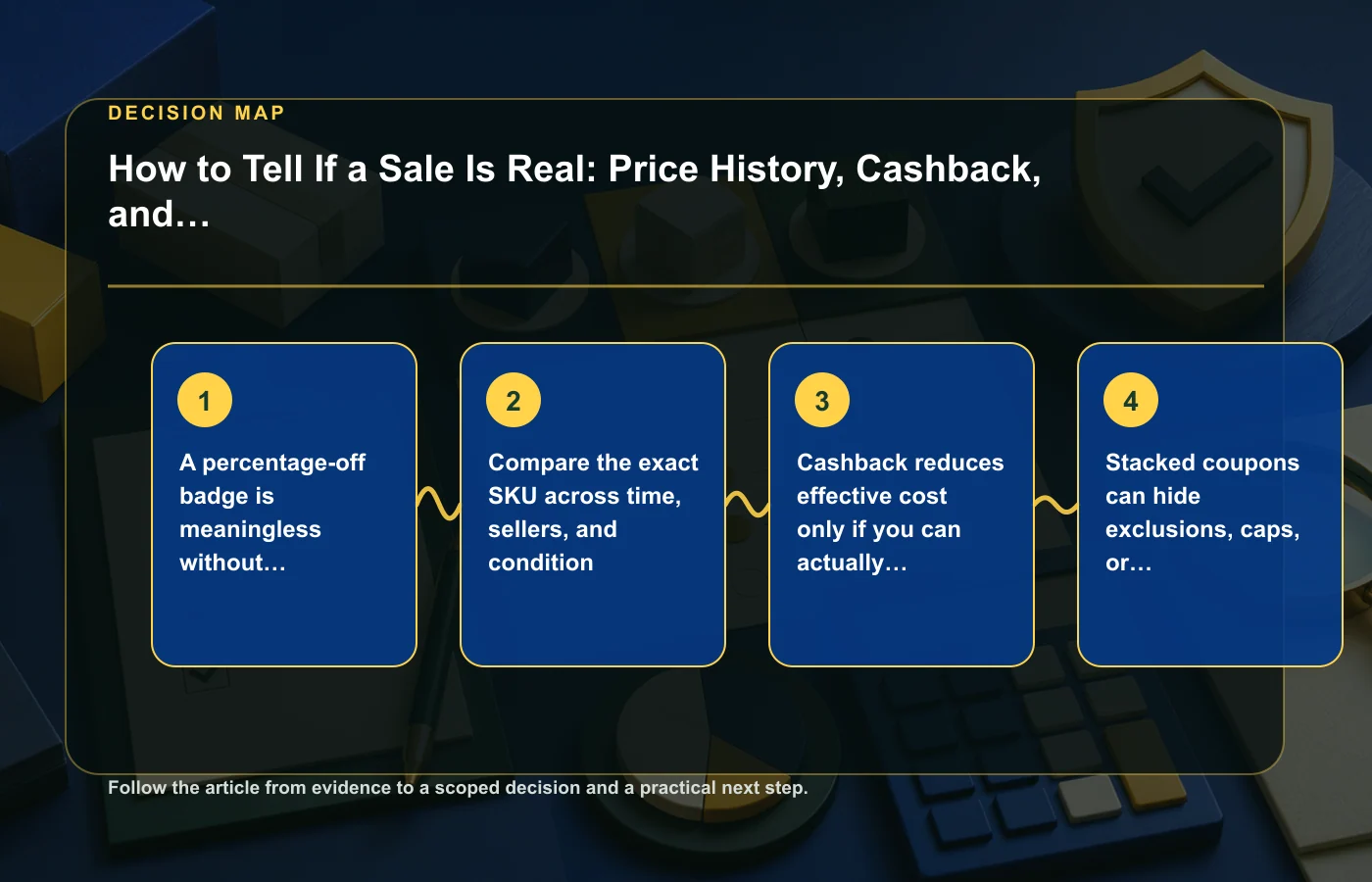
A percentage-off badge needs a credible reference price
The formula for a discount percentage is easy; the difficult part is deciding whether the reference price is meaningful. If a seller says an item is "30% off," ask 30% off what? The answer should be tied to a price that represents a real, comparable offer rather than a number that exists only to make the discount look large.
FTC guidance on deceptive pricing is relevant because former-price and comparison-price claims can mislead when the baseline is not genuine or clearly represented. A buyer does not need to conduct a legal analysis at checkout, but should avoid treating the badge as independent evidence.
Rebuild the discount from raw numbers
- Record the current price.
- Record the claimed reference price.
- Check whether the reference is for the same SKU and condition.
- Look at recent price history when available.
- Calculate the percentage yourself if the number affects the decision.
If the current price appears regularly in recent history, the "sale" may still be a reasonable offer, but it is not necessarily an unusually rare opportunity.
Compare the exact SKU across time and sellers
Price history becomes unreliable when the product quietly changes. Storage capacity, size, color, bundle, condition, seller, or fulfillment can all make a lower number incomparable with the price you recorded earlier. The cleanest comparison tracks the exact SKU or configuration.
If the listing changes, start a new row rather than forcing the prices into one timeline. A refurbished item should not be used as proof that a new item's price fell, and a bundle should not be compared directly with the standalone product unless you separate the extra contents.
Save the transaction context
- Exact model or SKU.
- Condition.
- Seller.
- Fulfillment method if it affects the transaction.
- Bundle contents.
- Return and warranty terms.
If you need a broader condition framework, the refurbished/open-box/used guide explains why condition tiers should not be mixed in one price comparison.
Cashback lowers effective cost only if you can redeem it
Cashback is not the same thing as an immediate price reduction. It may depend on account eligibility, payment method, activation, purchase category, tracking, minimum spend, redemption timing, or a cap. If any of those conditions fail, the effective cost is higher than the optimistic calculation.
Do not subtract cashback automatically at checkout. First decide whether you meet the conditions and whether you are willing to wait for the reward. If the benefit arrives as points, store credit, or another restricted form, value it according to how you will actually use it rather than treating it as cash without qualification.
Use two totals
Keep one line for the checkout cost and another for the expected effective cost after cashback. That separation makes uncertainty visible.
| Cost line | Include |
|---|---|
| Checkout cost | Price paid now plus applicable transaction costs |
| Expected cashback | Only the amount you reasonably expect to qualify for |
| Effective cost | Checkout cost minus expected redeemable benefit |
If cashback is uncertain, run a second scenario with zero cashback. A deal that only works under the best-case reward scenario deserves more caution.
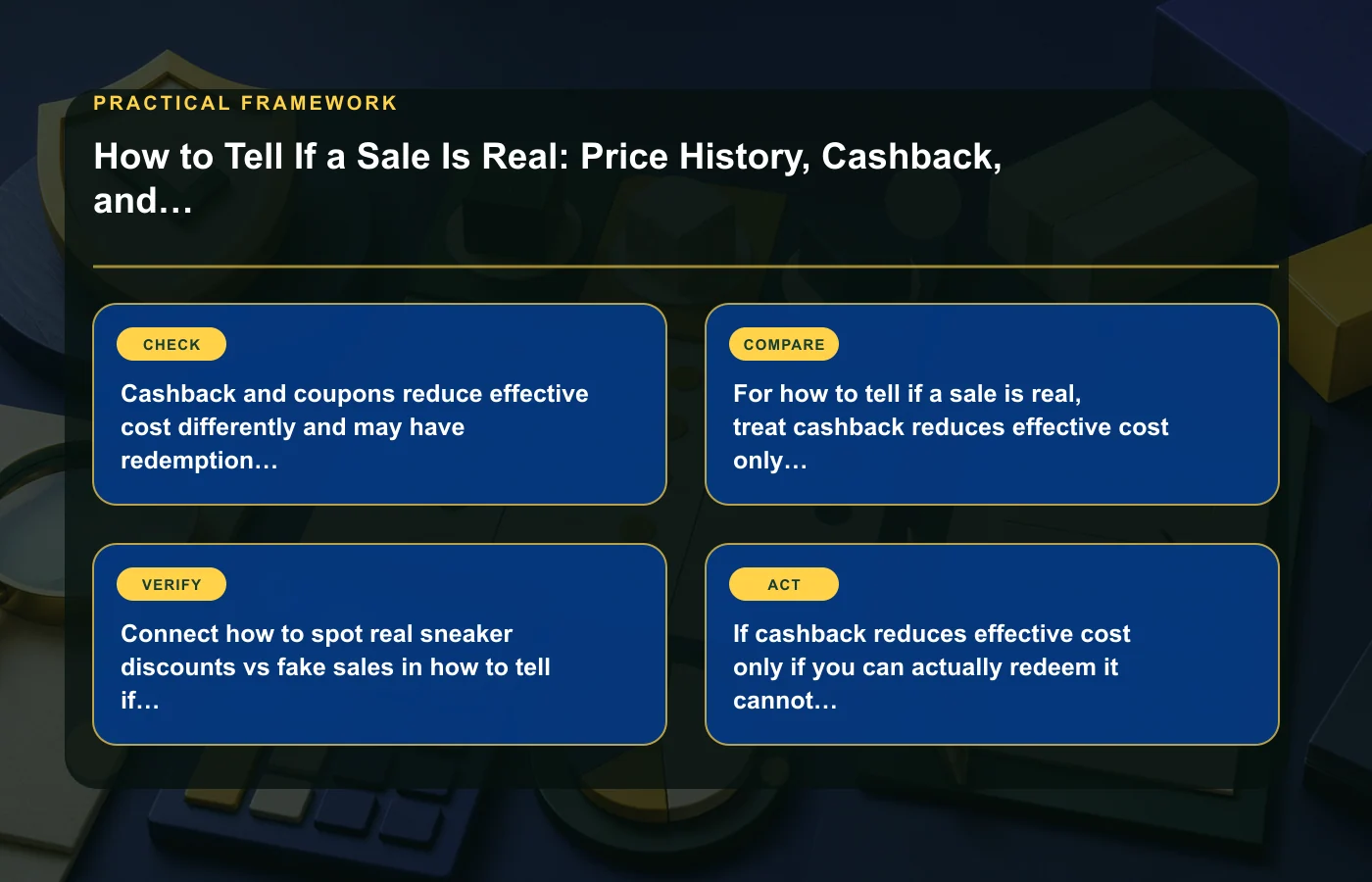
Stacked coupons can hide exclusions and caps
Multiple codes and promotions can create an impressive headline saving, but stacking rules are often conditional. A coupon may exclude certain brands or categories, require a minimum basket, have a maximum discount, or refuse to combine with another offer.
Build the deal at checkout before treating the stack as real. Apply each promotion in the sequence allowed by the seller and confirm the final total. Screenshots of promotional pages are less useful than the amount the checkout actually accepts.
Check the stack line by line
- Which promotions are automatic?
- Which require a code?
- Can the codes combine?
- Is there a minimum spend?
- Is there a maximum discount?
- Does applying one offer remove another?
If a promotion is tied to a membership, payment method, or future credit, keep that condition visible in the comparison rather than collapsing every benefit into one "discount" number.
Limited-time wording does not prove a historic low
Urgency and price rarity are different claims. "Ends tonight," a countdown timer, or a seasonal event can tell you that a promotion is presented as time-limited. It does not establish that the current price is lower than what was available recently or what may appear again.
The best antidote is a timestamped record. Save the current price before the event, during it, and—if timing allows—after it. This turns "limited time" from an emotional cue into a piece of data that can be compared with actual history.
Set your own deadline
A seller's countdown should not replace your purchase criteria. Decide when you genuinely need the product and what combination of price, configuration, and terms is acceptable. If the deal meets your threshold, you can buy without pretending it is the lowest possible price. If it does not, a timer does not make the product fit better.
The renewed-versus-refurbished guide is useful when condition labels are part of the offer, because condition differences can easily be mistaken for discount differences.
Calculate the deal from the final checkout backward
A reliable sale check starts with what you actually pay and works backward through the claimed savings. Record the checkout total, then identify which part comes from a lower product price, which comes from a coupon, which depends on cashback, and which is simply the seller's reference-price comparison.
- Checkout price: amount charged now.
- Immediate reductions: coupons or automatic discounts that actually applied.
- Deferred benefits: cashback, points, or credits that arrive later.
- Reference price: baseline used to support the percentage-off claim.
- Historical context: comparable past prices for the same offer.
This structure prevents a future reward from being confused with an immediate saving and prevents a large reference-price gap from being confused with real historical rarity.
Keep a five-minute sale-check worksheet
You do not need a complex spreadsheet for every purchase. A short worksheet can answer the important questions quickly.
| Field | What to write |
|---|---|
| Exact product | SKU/configuration and condition |
| Current checkout price | What you pay now |
| Recent comparable price | Same item and seller context |
| Coupon | Actual amount accepted |
| Cashback | Expected redeemable amount and conditions |
| Decision | Buy, wait, or needs more verification |
For more general purchase frameworks, the buying guides section follows the same principle: verify comparable facts first, then make the decision.
Separate reference-price types before comparing them
Not every crossed-out number means the same thing. A seller may be comparing the current offer with a former selling price, a manufacturer suggested price, another seller's price, or another benchmark defined by the promotion. Those reference types should not be blended together.
When the basis is stated, copy it into your notes. If it is not clear, treat the percentage as incomplete information and rely more heavily on the actual history of the exact offer. A transparent reference price is easier to evaluate than a larger but unexplained discount.
Ask one question before trusting the badge
"What price is this percentage calculated from?" If you cannot answer that from the page or terms, the badge has limited analytical value. You can still judge the current price on its own merits, but you should not let an opaque reference create artificial urgency.
Do not let a lower price hide weaker transaction terms
A sale comparison can become misleading when the cheaper offer changes the seller, return window, warranty, fulfillment, or condition. Those differences are not always easy to convert into dollars, but they can materially change the transaction risk.
Keep a second column beside price for terms that changed. If the lower offer has a different return policy or comes from a different condition tier, label it as a different transaction. The goal is not to assign a universal monetary value to better protection; it is to prevent a price drop from hiding a tradeoff.
- Same seller or a different seller?
- Same condition tier?
- Same return window?
- Same warranty provider and coverage?
- Same bundle and fulfillment?
If those factors differ, compare the offers as alternatives rather than as two points on one clean price-history line.
Decide what "good enough" means before the event
People often keep searching because there is always a chance of a lower future price. A simple decision rule can stop that loop. Define the exact configuration you need, an acceptable seller and condition, the protection you require, and a price level you consider reasonable based on observed history.
When the offer meets those conditions, the decision does not depend on proving that you found the absolute lowest price. You have found a price that is supported by evidence and fits your requirements. That is a more useful buyer standard than chasing an unknowable perfect deal. Save the evidence that supported the decision so you can compare future promotions without rebuilding the baseline from memory later.
That record also makes later sale events easier to compare on the same basis.
FAQ: How to tell if a sale is real
Does a high percentage discount mean the price is unusually low?
No. The percentage is only as meaningful as its reference price. Check the same product's recent price history and the basis for the comparison.
Should cashback count as a discount?
It can reduce effective cost if you qualify and redeem it, but it is not the same as an immediate price reduction. Keep checkout cost and expected cashback separate.
How do I compare a bundle with a standalone product?
Separate the core product from the extras and decide whether those extras have real value to you. Do not use a larger bundle total as proof that the standalone product itself is cheaper.
Does a countdown timer prove I should buy now?
No. A time limit does not prove the price is historically rare. Use your own deadline and price-history evidence rather than urgency alone.
How this page was prepared
Reviewed by My Deal Junction Standards Editor. Claims, terminology, and time-sensitive details were checked against the sources listed below and the page was last updated September 16, 2026.
AI-assisted tools supported research organization or drafting; editorial review remained responsible for source selection and the published conclusions.
Sources and verification
Primary and authoritative references used to verify this article: